
Showing posts with label evolution. Show all posts
Showing posts with label evolution. Show all posts
Wednesday, March 24, 2021


Saturday, October 24, 2020
Saturday Science: Earth: A Biography: A Sidebar: Autumn Color

Chlorophyll is one of a class of photoshymthetic pigments that first made their appearance roughly three billion years ago. There are others -- look at any number of decorative plants and shrubs, which show red, yellow, orange and various combinations of color. And they all enable photosynthesis, which not only allows plants (and some bacteria) to make their own food, but produces as a byproduct the oxygen in the air we breathe.
No one is quite sure how some bacteria -- known officially as "cyanobacteria" -- first made use of photosynthetic pigments, but they did. One of the immediate results was oceans full of rust, which sank to the bottom and created what are nown as "banded iron formations" -- the source of mose of our iron ore. Once that was accomplaished, the oxygen that these bacteria were producing escaped into the atmosphere -- which at that point was composed of nitrogen, carbon dioxide, and water vapoor - and created the ozone layer, which proved to be of great significance: the ozone layer filters out most of the harmful radition from the sun and enabled life to move from the oceans to the land.
Scientists believe that land plants are descended from green algae, mostly because they contain the same kind of chlorophyll. It actually makes a lot of sense -- who has not seen a clump of algae on a shore, periodically left high and dry as the tide goes out. And the first land plants were mosses and selaginellas, which require a moist environment.
But back to fall color: What we're seeing after the chlorophyll breaks down is the other pigments, which will last until the leaves fall. There's even an order in which this all happens, at least as far as the trees themselves are concenred: here in Chicago, the firt to turn are the locusts and ashes, followed by maples and basswoods. Mixed in there are birches, ginkos, and the various others that get planted in the city. Oaks are notable for having prsisent leaves -- they turn color and die, but they don't fall. That's probably why squirrels pefer them for nest-building: the leaves hold to the twigs so you bedroom isn't constantly falling apart.
So that's all I have to say for now about fall color and how it fits in which the scheme of things.
Saturday, July 27, 2019
Saturday Science: Darwin Who?
A new poll from Gallup that has some sobering implications:
My first reaction is to think that this is a result of the "dumbing of America" due to the right's attacks on public education, but if you look at the timeline, the only significant change is the increase in those who believe that man evolved without divine interference.
And of course, it's tied to religious belief and education:
Unfortunately, the report doesn't include any information on methodology -- where and how the survey was taken, the actual questions asked (particularly a more precise identification of religious affiliation: were there any responses from non-Christians? I.e., Hindus, Muslims, Buddhists, etc. Apparently, Gallup believes there is only one religion in this country.)
I will note, however, that according this survey, the more Christian you are, the less likely you are to live in the real world.
Forty percent of U.S. adults ascribe to a strictly creationist view of human origins, believing that God created them in their present form within roughly the past 10,000 years. However, more Americans continue to think that humans evolved over millions of years -- either with God's guidance (33%) or, increasingly, without God's involvement at all (22%).
The latest findings, from a June 3-16 Gallup poll, have not changed significantly from the last reading in 2017. However, the 22% of Americans today who do not believe God had any role in human evolution marks a record high dating back to 1982. This figure has changed more than the other two have over the years and coincides with an increasing number of Americans saying they have no religious identification.

My first reaction is to think that this is a result of the "dumbing of America" due to the right's attacks on public education, but if you look at the timeline, the only significant change is the increase in those who believe that man evolved without divine interference.
And of course, it's tied to religious belief and education:
As has been the case historically, Americans' views on evolution and creationism vary sharply based on their religious identification, how often they attend church and their education level.
Majorities of Protestants (56%) and those who attend church at least once a week (68%) believe that God created humans in their present form. Meanwhile, 59% of those who do not identify with any religion believe in evolution without any intervention from God.
Those with a college degree are much more likely to believe in evolution than creationism, while the opposite is true of those without a college degree. However, even among adults with a college degree, more believe God had a role in evolution than say it occurred without God.
Unfortunately, the report doesn't include any information on methodology -- where and how the survey was taken, the actual questions asked (particularly a more precise identification of religious affiliation: were there any responses from non-Christians? I.e., Hindus, Muslims, Buddhists, etc. Apparently, Gallup believes there is only one religion in this country.)
I will note, however, that according this survey, the more Christian you are, the less likely you are to live in the real world.
Saturday, January 19, 2019
Saturday Science: Life Is Inevitable
One of the big questions in evolution (well, more like, that sets the stage for evolution) is the origin of life. Scientists have been pretty much stumped on this one, although there have been some interesting experiments in the past that have given us some possible answers, but now someone seems to have developed a theoretical framework for the beginnings:
The article points out that creationists are fond of citing the Second Law of Thermodynamics as a refutation of non-divine theories of the origin of life, but they misrepresent the Second Law:
That's the key point, and one that creationists try very hard to ignore: the Earth is not a closed system -- it gets energy from an outside source -- the sun -- and there are, and have been, injections of matter from outside --meteors and a more or less constant rain of interstellar dust.
It's an interesting article, and worth reading.
By the way, if you're interested in what the first living organisms were like, here's an interesting article.
Darwin also didn’t have anything to say about how life got started in the first place — which still leaves a mighty big role for God to play, for those who are so inclined. But that could be about to change, and things could get a whole lot worse for creationists because of Jeremy England, a young MIT professor who’s proposed a theory, based in thermodynamics, showing that the emergence of life was not accidental, but necessary. “[U]nder certain conditions, matter inexorably acquires the key physical attribute associated with life,” he was quoted as saying in an article in Quanta magazine early in 2014, that’s since been republished by Scientific American and, more recently, by Business Insider. In essence, he’s saying, life itself evolved out of simpler non-living systems.
The article points out that creationists are fond of citing the Second Law of Thermodynamics as a refutation of non-divine theories of the origin of life, but they misrepresent the Second Law:
Creationists thus misinterpret the 2nd law to say that things invariably progress from order to disorder.
However, they neglect the fact that life is not a closed system. The sun provides more than enough energy to drive things. If a mature tomato plant can have more usable energy than the seed it grew from, why should anyone expect that the next generation of tomatoes can’t have more usable energy still?
That's the key point, and one that creationists try very hard to ignore: the Earth is not a closed system -- it gets energy from an outside source -- the sun -- and there are, and have been, injections of matter from outside --meteors and a more or less constant rain of interstellar dust.
It's an interesting article, and worth reading.
By the way, if you're interested in what the first living organisms were like, here's an interesting article.
Remains of microorganisms at least 3,770 million years old have been discovered by an international team led by UCL scientists, providing direct evidence of one of the oldest life forms on Earth.
Tiny filaments and tubes formed by bacteria that lived on iron were found encased in quartz layers in the Nuvvuagittuq Supracrustal Belt (NSB), Quebec, Canada.
The NSB contains some of the oldest sedimentary rocks known on Earth which likely formed part of an iron-rich deep-sea hydrothermal vent system that provided a habitat for Earth's first life forms between 3,770 and 4,300 million years ago. "Our discovery supports the idea that life emerged from hot, seafloor vents shortly after planet Earth formed. This speedy appearance of life on Earth fits with other evidence of recently discovered 3,700 million year old sedimentary mounds that were shaped by microorganisms," explained first author, PhD student Matthew Dodd (UCL Earth Sciences and the London Centre for Nanotechnology).
 |
| Haematite tubes from the NSB hydrothermal vent deposits that represent the oldest microfossils and evidence for life on Earth. Credit: Matthew Dodd |
Saturday, December 08, 2018
Saturday Science: Earth: A Biography: The Cambrian Explosion
At long last. It's been a bit weird around here, but I'm getting back on track.
The story so far: Over the course of about three billion years or so, after earth cooled off a bit after its formation, we've seen living organisms develop from organic molecules in the environment. We're not sure how these molecules were organized (or organized themselves) into actual critters, but they did, first simple single-celled organisms, prokaryotes, and eventually eukaryotes, which are the forerunners of pretty much everything. Those first organisms are actually an assumption: in rocks dating to 3.8 to 3.5 billion years ago, there are traces of carbon in patterns similar -- very similar -- to those left by bacteria today.
The prokaryotes -- Archaea and Bacteria -- are still with us, but they haven't developed all that much from where they were 600 million years ago. The big difference, and it is a big one, is that the eukaryotes have a cell nucleus, which contains the cell's DNA, and various organelles, some with their own DNA, that control various processes within the cell. A couple of important points: we have fossil records of organisms with exoskeletons from about 550 million years ago (hereinafter known as "mya"). To state the obvious, this is a strong indicator that we already have fairly complex organisms that may be divided into "predators" and "prey." (The major reason to develop an exoskeleton is that something wants to eat you.)
And somewhere along the line, they discovered, or invented, sex, which is critically important: before this, reproduction was asexual, producing offspring that were exact duplicates of their parent (usually -- sometimes mutations would happen that would introduce some variation, but this was a rare and chancy occurrence). The advantage of sex is that it automatically introduces a range of characteristics into the offspring, providing them with a much greater ability to adapt to changing conditions -- and, as we've seen, conditions were pretty much constantly changing. (A side note: I can't find any contemporary references, but I seem to remember from reading long ago that in the early stages, sexual reproduction was pretty much a free-for-all: there were no species yet. At some point regulatory genes developed that halted the exchange of DNA between unlike organisms: we now have species.)
Now, this may seem like a lot of assumptions with no hard evidence, but we know that the earth started out with organic compounds and somewhere along the line living creatures appeared. We're talking, from the very beginnings to the opening of the Cambrian, roughly three billion years. Remember that evolution operates through generations, and that even without sexual reproduction, there are genetic variations caused by mutations. And remember that the length of a generation for a single-celled organism is about fifteen minutes. That's a lot of generations, and potentially a lot of mutations, and when you factor in sexual reproduction, which introduces even more variability into the genome, pretty much anything is possible. And so we arrive at the Cambrian Period.
Let's take a look at what the world looked like at the point:
As you can see, most of the land was concentrated in the Southern Hemisphere, and there was a lot of ocean. Since the land was pretty much uninhabitable, that was a good thing.
 At the beginning of this period, we have some multicellular organisms -- simple sponges or jellyfish-like animals, most of which were stationary, although some did move around. The majority of organisms were single-celled and formed a mat on the ocean floor, feeding directly on the minerals in the rocks. Some of the multicellular animals fed on them.
There's some debate as to what caused what happened next. The prevailing theory has been that the increase in oxygen levels (due, as you'll no doubt remember, to the emergence of cyanobacteria and their relatives, which introduced photosynthesis into the mix, releasing free oxygen as a waste product) made multicellular organisms possible. Some researchers are maintaining that the oxygen levels not only varied over time, but were not great enough to permit the existence of larger multicellular organisms. (Remember that we're dealing with organisms that mostly don't have respiratory systems yet: they're getting their oxygen, as well as their daily sustenance, directly from the environment.) I think it's apropos at this point to introduce the concept of threshold events: things may go along close to the status quo while conditions are changing, and then you reach a tipping point that involves sudden, dramatic changes. We'll see this again and again in the course of life on earth.
What makes this event, or series of events, so important is that almost all the major groups of organisms -- phyla, to be technical -- make their first appearance. And these are the phyla that still exist today (with a few exceptions that didn't make it this far). To give you an idea of what it might have looked like:
Looks pretty alien, doesn't it? But just about all of those kinds of organisms are still around -- or their descendants are.
The Cambrian Explosion necessarily runs into the Ordovician period: diversity increased, some organisms vanished, and some began to colonize the land. By this point there is enough free oxygen in the atmosphere to form an ozone layer, filtering out the worst of the sun's ultraviolet, which had before this kept living organisms confined to the oceans. So, some brave bacteria, fungi, etc. essayed that new environment, sticking close to the water, and perhaps living in the shallows. The end result of this is that as they digested the mineral-rich sediments, and then died and decayed, they created soil that was capable of supporting life. (There is evidence that some animals were exploring the land well before this -- about 530 mya; there is no evidence, however, that they hung around for any length of time.) The first plants -- and probably a few arthropods -- were thus able to survive, although they, too, stuck close to the water: they hadn't yet evolved the means to survive without it.
So we're ready for the invasion of the land.
The story so far: Over the course of about three billion years or so, after earth cooled off a bit after its formation, we've seen living organisms develop from organic molecules in the environment. We're not sure how these molecules were organized (or organized themselves) into actual critters, but they did, first simple single-celled organisms, prokaryotes, and eventually eukaryotes, which are the forerunners of pretty much everything. Those first organisms are actually an assumption: in rocks dating to 3.8 to 3.5 billion years ago, there are traces of carbon in patterns similar -- very similar -- to those left by bacteria today.
The prokaryotes -- Archaea and Bacteria -- are still with us, but they haven't developed all that much from where they were 600 million years ago. The big difference, and it is a big one, is that the eukaryotes have a cell nucleus, which contains the cell's DNA, and various organelles, some with their own DNA, that control various processes within the cell. A couple of important points: we have fossil records of organisms with exoskeletons from about 550 million years ago (hereinafter known as "mya"). To state the obvious, this is a strong indicator that we already have fairly complex organisms that may be divided into "predators" and "prey." (The major reason to develop an exoskeleton is that something wants to eat you.)
And somewhere along the line, they discovered, or invented, sex, which is critically important: before this, reproduction was asexual, producing offspring that were exact duplicates of their parent (usually -- sometimes mutations would happen that would introduce some variation, but this was a rare and chancy occurrence). The advantage of sex is that it automatically introduces a range of characteristics into the offspring, providing them with a much greater ability to adapt to changing conditions -- and, as we've seen, conditions were pretty much constantly changing. (A side note: I can't find any contemporary references, but I seem to remember from reading long ago that in the early stages, sexual reproduction was pretty much a free-for-all: there were no species yet. At some point regulatory genes developed that halted the exchange of DNA between unlike organisms: we now have species.)
Now, this may seem like a lot of assumptions with no hard evidence, but we know that the earth started out with organic compounds and somewhere along the line living creatures appeared. We're talking, from the very beginnings to the opening of the Cambrian, roughly three billion years. Remember that evolution operates through generations, and that even without sexual reproduction, there are genetic variations caused by mutations. And remember that the length of a generation for a single-celled organism is about fifteen minutes. That's a lot of generations, and potentially a lot of mutations, and when you factor in sexual reproduction, which introduces even more variability into the genome, pretty much anything is possible. And so we arrive at the Cambrian Period.
Let's take a look at what the world looked like at the point:
 |
| Early Cambrian continnents. Image: New World Encyclopedia |
As you can see, most of the land was concentrated in the Southern Hemisphere, and there was a lot of ocean. Since the land was pretty much uninhabitable, that was a good thing.
There's some debate as to what caused what happened next. The prevailing theory has been that the increase in oxygen levels (due, as you'll no doubt remember, to the emergence of cyanobacteria and their relatives, which introduced photosynthesis into the mix, releasing free oxygen as a waste product) made multicellular organisms possible. Some researchers are maintaining that the oxygen levels not only varied over time, but were not great enough to permit the existence of larger multicellular organisms. (Remember that we're dealing with organisms that mostly don't have respiratory systems yet: they're getting their oxygen, as well as their daily sustenance, directly from the environment.) I think it's apropos at this point to introduce the concept of threshold events: things may go along close to the status quo while conditions are changing, and then you reach a tipping point that involves sudden, dramatic changes. We'll see this again and again in the course of life on earth.
What makes this event, or series of events, so important is that almost all the major groups of organisms -- phyla, to be technical -- make their first appearance. And these are the phyla that still exist today (with a few exceptions that didn't make it this far). To give you an idea of what it might have looked like:
Looks pretty alien, doesn't it? But just about all of those kinds of organisms are still around -- or their descendants are.
The Cambrian Explosion necessarily runs into the Ordovician period: diversity increased, some organisms vanished, and some began to colonize the land. By this point there is enough free oxygen in the atmosphere to form an ozone layer, filtering out the worst of the sun's ultraviolet, which had before this kept living organisms confined to the oceans. So, some brave bacteria, fungi, etc. essayed that new environment, sticking close to the water, and perhaps living in the shallows. The end result of this is that as they digested the mineral-rich sediments, and then died and decayed, they created soil that was capable of supporting life. (There is evidence that some animals were exploring the land well before this -- about 530 mya; there is no evidence, however, that they hung around for any length of time.) The first plants -- and probably a few arthropods -- were thus able to survive, although they, too, stuck close to the water: they hadn't yet evolved the means to survive without it.
So we're ready for the invasion of the land.
Sunday, October 21, 2018
This Kid Gets It
The kid knows exactly why dinosaurs became extinct:
So why doesn't Answers in Genesis get it?
Via Friendly Atheist.
Watch this adorable 3-year-old paleontologist brilliantly explain how the dinosaurs became extinct 😍 pic.twitter.com/U8RlasX4S8
— 🧙🏾♀️💫 (@Blk_Hermione) October 19, 2018
So why doesn't Answers in Genesis get it?
Via Friendly Atheist.
Saturday, August 25, 2018
Saturday Science: On Racial Purity
"White supremacists" and other racists are in the news a lot over the past eighteen months (wonder why?). From a scientific standpoint, they're full of shit: genome mapping of individuals from various races has demonstrated that individuals from different races may be more similar than individuals from the same race. (Keep in mind that we share about 98% of our genes with chimpanzees, so how much difference is there going to be between human races?)
New findings make it even more depressing for racial purity advocates:
And then there's interbreeding between those groups and Homo sapiens:
Side note: Moderns humans migrated to New Guinea and Australia about 40,000-50,000 years ago.
And another note: In classical taxonomy (the "science of naming") a species consists of a population whose members produce viable (i.e., fertile) offspring among themselves, but produce sterile offspring (is any) when they mate outside the group. Orchids, however, blow this idea out of the water: they are what's known as "genetically labile," which is a face-saving way of saying that they interbreed freely and produce fertile offspring across species -- and even genera: hobbyists have produced hybrids from up to five genera that are viable. From the findings in this article, it looks as though that genetic lability isn't confined to orchids.
So, it starts to look as though the only "racially pure" modern humans are Africans (and even there, there are traces of as yet unknown non-Homo sapiens ancestors).
Take that, David Duke.
Further reading:
On Neanderthals.
On Denisovans.
On interbreeding between archaic and modern humans.
On the genetic difference between "races".
New findings make it even more depressing for racial purity advocates:
Denny was an inter-species love child.
Her mother was a Neanderthal, but her father was Denisovan, a distinct species of primitive human that also roamed the Eurasian continent 50,000 years ago, scientists reported Wednesday in the journal Nature.
Nicknamed by Oxford University scientists, Denisova 11 — her official name — was at least 13 when she died, for reasons unknown.
“There was earlier evidence of interbreeding between different hominin, or early human, groups,” said lead author Vivian Slon, a researcher at the Max Planck Institute for Evolutionary Anthropology.
“But this is the first time that we have found a direct, first-generation offspring,” she told AFP.
Denny’s surprising pedigree was unlocked from a bone fragment unearthed in 2012 by Russian archeologists at the Denisova Cave in the Altai Mountains of Siberia.
Analysis of the bone’s DNA left no doubt: the chromosomes were a 50-50 mix of Neanderthal and Denisovan, two distinct species of early humans that split apart between 400,000 to 500,000 years ago.
And then there's interbreeding between those groups and Homo sapiens:
But the most compelling evidence that inter-species hanky-panky in Late Pleistocene Eurasia may not have been that rare lies in the genes of contemporary humans.
About two percent of DNA in non-Africans across the globe today originate with Neanderthals, earlier studies have shown.
Denisovan remnants are also widespread, though less evenly.
“We find traces of Denisovan DNA — less than one percent — everywhere in Asia and among native Americans,” said Paabo.
“Aboriginal Australians and people in Papua New Guinea have about five percent.”
Side note: Moderns humans migrated to New Guinea and Australia about 40,000-50,000 years ago.
And another note: In classical taxonomy (the "science of naming") a species consists of a population whose members produce viable (i.e., fertile) offspring among themselves, but produce sterile offspring (is any) when they mate outside the group. Orchids, however, blow this idea out of the water: they are what's known as "genetically labile," which is a face-saving way of saying that they interbreed freely and produce fertile offspring across species -- and even genera: hobbyists have produced hybrids from up to five genera that are viable. From the findings in this article, it looks as though that genetic lability isn't confined to orchids.
So, it starts to look as though the only "racially pure" modern humans are Africans (and even there, there are traces of as yet unknown non-Homo sapiens ancestors).
Take that, David Duke.
Further reading:
On Neanderthals.
On Denisovans.
On interbreeding between archaic and modern humans.
On the genetic difference between "races".
Saturday, March 10, 2018
Saturday Science: Trees

I did a little research and discovered that ginkgos are most closely related to cycads.
I also discovered that, although they make seeds, they don't have flowers, again like conifers. I spent a bit of time last spring observing the conifers planted around Lincoln Park Conservatory, and, yep: they don't have flowers, just little buds that release pollen and little proto-cones that form seeds when the pollen lands on them.
By contrast, the growth habit of most flowering trees (again, usually) is spreading: they want to capture as much light at possible, and any branch may become a secondary trunk.
Just some thoughts. I'll probably work this into a post in Earth: A Biography (which I'm going to get back into soon), but it needs more research.
(Footnote: And I discovered an error in the signage in the Fern Room at the Conservatory, which starts off "A small dinosaur would feel right at home in this room" since it's all ferns, selaginellas, tree ferns -- and cycads. It goes on to state that seeds hadn't evolved yet, which is not the case: seed-bearing plants first appeared about 360 million years ago, long before the dinosaurs; flowers, however, didn't appear until much later, while dinosaurs were running around doing dinosaur things. In fact, cycads are seed-bearing.)
Saturday, June 10, 2017
Saturday Science: Origins
A couple of articles that caught my attention this week, both about beginnings.
First, another note on that old conundrum, where did life originate?
No one, to my knowledge, has made a case for this being an either/or question. I've already explored some of the possibilities, and while this finding adds support to the "it came from outer space" theory, it doesn't address the "it came from the deeps" theory. I, for one, see absolutely no reason why it couldn't have been both.
The other "origins" article hits a little closer to home: when and where did modern humans originate? It's not as recently as we had thought:
Once again, we have a rather ambiguous question: the evidence from mitochondrial DNA is pretty definitive that we all descended from a small group of women living in East Africa about 200,000 years ago -- but that doesn't really address where and when the ancestors of those women originated.
It all comes down to asking the right questions.
First, another note on that old conundrum, where did life originate?
Scientists believe that, along with the rest of our solar system, Earth arose from material left over after the Sun was formed. But how living organisms came about is a matter for debate. As Wired points out, one theory holds that life came about on Earth independently from the Sun, after the planet was formed. The other states that the ingredients of life were were formed in a solar nebula and then arrived on Earth via comets. "The detection of this molecule points toward the latter theory," Rafael Martín-Doménech, one of the leaders of Centro de Astrobiología, told Wired.
No one, to my knowledge, has made a case for this being an either/or question. I've already explored some of the possibilities, and while this finding adds support to the "it came from outer space" theory, it doesn't address the "it came from the deeps" theory. I, for one, see absolutely no reason why it couldn't have been both.
The other "origins" article hits a little closer to home: when and where did modern humans originate? It's not as recently as we had thought:
According to the textbooks, all humans living today descended from a population that lived in east Africa around 200,000 years ago. This is based on reliable evidence, including genetic analyses of people from around the globe and fossil finds from Ethiopia of human-like skeletal remains from 195,000–165,000 years ago.
Now a large scientific team that I was part of has discovered new fossil bones and stone tools that challenge this view. The new studies, published in Nature, push back the origins of our species by 100,000 years and suggest that early humans likely spanned across most of the African continent at the time.
Once again, we have a rather ambiguous question: the evidence from mitochondrial DNA is pretty definitive that we all descended from a small group of women living in East Africa about 200,000 years ago -- but that doesn't really address where and when the ancestors of those women originated.
It all comes down to asking the right questions.
Friday, December 09, 2016
Saturday Science on Friday: Dinosaur Feathers
Just a little bit, 'cause it's exciting. They've found them, still attached to the dinosaur -- well, to part of it.
Click through and read the whole thing. Lots more information, and lots of gorgeous -- and very informative -- pictures.
The tail of a 99-million-year-old dinosaur, including bones, soft tissue, and even feathers, has been found preserved in amber, according to a report published today in the journal Current Biology.
While individual dinosaur-era feathers have been found in amber, and evidence for feathered dinosaurs is captured in fossil impressions, this is the first time that scientists are able to clearly associate well-preserved feathers with a dinosaur, and in turn gain a better understanding of the evolution and structure of dinosaur feathers. . . .
The semitranslucent mid-Cretaceous amber sample, roughly the size and shape of a dried apricot, captures one of the earliest moments of differentiation between the feathers of birds of flight and the feathers of dinosaurs. (Learn more about the evolutionary relationship between dinosaurs and birds.)
Inside the lump of resin is a 1.4-inch appendage covered in delicate feathers, described as chestnut brown with a pale or white underside.
Click through and read the whole thing. Lots more information, and lots of gorgeous -- and very informative -- pictures.
Sunday, November 20, 2016
Giggle du Jour
You may know that the creationists/IDers figure their crushing argument against evolution is the Second Law of Thermodynamics. Their argument, from this post by PZ Myers.:
Offhand, I'd say everyone knows about it.

One of the most basic laws in the universe is the Second Law of Thermodynamics. This states that as time goes by, entropy in an environment will increase. Evolution argues differently against a law that is accepted EVERYWHERE BY EVERYONE. Evolution says that we started out simple, and over time became more complex. That just isn’t possible: UNLESS there is a giant outside source of energy supplying the Earth with huge amounts of energy. If there were such a source, scientists would certainly know about it.
Offhand, I'd say everyone knows about it.
Saturday, November 19, 2016
Saturday Science: Earth: A Biography: Setting the Stage
Before we dive headlong into the Cambrian Era and all the excitement that was part of it, a few words about some basics of evolution.
It's important to remember the evolution -- that is, change over time -- operates in populations. For example, you have a species adapted to a particular environment -- say, an area bordering on a wetland. A group of individuals of that species starts to move into a slightly different environment -- let's say slightly farther from the wetland, up in the hills, where it's drier. Because sexual reproduction gives genetic variability in a population, some members of that group are able to take better advantage of the new environment -- they don't need to drink as often, or they are better able to obtain moisture from their food. Those individuals then are stronger and healthier and will produce more offspring, which inherit those favorable characteristics. After enough time has passed, this new population becomes a new species -- that is, in the classical meaning of the term, they no longer interbreed freely with the parent population. (At some point, probably soon, I will discuss the vagaries of taxonomy and how nature tends not to pay attention to our ideas about how it should operate.) Thus, through the operation of genetic variability in a particular environment, we have a new genotype: the population has evolved.
 The other major factor here is geography, which is a basic and essential component of the environment. You may remember that long, long ago, when this all started, there wasn't very much land on earth. What there was was the result of vulcanism -- lots of volcanoes and such. Over time, as the rains came and rivers formed, sediments began to be added to the mix -- sandstone and the like -- and with the advent of skeletons in single-celled organisms, we have limestone. (Pinning down the earliest limestone is next to impossible, simply because it erodes so easily. This article discusses some of the problems in finding early specimens, and also gives a hint that limestone may very well predate the most common estimate of origins in the early Cambrian -- early fossils have been found in rocks that most likely predate the Cambrian, that is, they are older than about 535 million years.)
It's also worth remembering that the land wasn't uniform -- there were mountains, there were valleys, there were lots of variations in topography. This held true as much for the underwater portions of the earth as for dry land. Thus, even at this early date, we have a series of different environments largely determined by the shape of the land. All this land-building is important because most of what we're going to be discussing happened on land, although the great migration from sea to land isn't going to happen for a couple hundred million years.
So, by the beginning of the Cambrian, after a couple billion years of land-building, we have something like this:

This more or less sets the stage for the Cambrian Explosion, that period starting about 550 million years ago when all the present-day animal groups first made their appearance. Here's a taste of what we're in for.

It's important to remember the evolution -- that is, change over time -- operates in populations. For example, you have a species adapted to a particular environment -- say, an area bordering on a wetland. A group of individuals of that species starts to move into a slightly different environment -- let's say slightly farther from the wetland, up in the hills, where it's drier. Because sexual reproduction gives genetic variability in a population, some members of that group are able to take better advantage of the new environment -- they don't need to drink as often, or they are better able to obtain moisture from their food. Those individuals then are stronger and healthier and will produce more offspring, which inherit those favorable characteristics. After enough time has passed, this new population becomes a new species -- that is, in the classical meaning of the term, they no longer interbreed freely with the parent population. (At some point, probably soon, I will discuss the vagaries of taxonomy and how nature tends not to pay attention to our ideas about how it should operate.) Thus, through the operation of genetic variability in a particular environment, we have a new genotype: the population has evolved.

It's also worth remembering that the land wasn't uniform -- there were mountains, there were valleys, there were lots of variations in topography. This held true as much for the underwater portions of the earth as for dry land. Thus, even at this early date, we have a series of different environments largely determined by the shape of the land. All this land-building is important because most of what we're going to be discussing happened on land, although the great migration from sea to land isn't going to happen for a couple hundred million years.
So, by the beginning of the Cambrian, after a couple billion years of land-building, we have something like this:
This more or less sets the stage for the Cambrian Explosion, that period starting about 550 million years ago when all the present-day animal groups first made their appearance. Here's a taste of what we're in for.
Saturday, November 12, 2016
Saturday Science: Earth: A Biography: Sex and the Single-Celled Organism
I'm back. Pretty much. The last couple of months have been -- well, not conducive to writing posts about science. But we're ready for the next installment of "Earth: A Biography."
Last time, or actually time before last, we were talking about the three groups of protists -- Archaeans, Bacteria, and Eukaryotes -- and their relationships, which are still somewhat unclear. One thing that's very important here is that somewhere along the line they discovered sex -- that is, reproduction not as a more-or-less automatic function of a single-celled organism, accomplished by the simple expedient of the organism duplicating itself, but as a rather more involved process in which genetic material is shared between two organisms.
(A sidebar: at one point, far in the misty past, single-celled organisms did share genetic material more or less randomly, to the extent that a concept such as "species" was meaningless. Somewhere along the line (and at this point I haven't found a source that even addresses it) there developed a sort of regulatory gene that would no longer allow that: the only genes that could be shared were those between like organisms. This is probably a precursor for reproduction, but that took a while.)
So, for sexual reproduction to "take over," so to speak, as the main form of reproduction in complex organisms, there has to be an advantage, or a complex of advantages that, from an evolutionary perspective, makes it more desirable than nonsexual reproduction.
As it turns out, there are a number of advantages: increased resistance to parasites and diseases, removal of deleterious genes, and genetic variation. This last is going to be very important: genetic variation gives rise, in turn, to novel genotypes -- new species, in other words. We're going to see the of this as we enter the Cambrian Era, in what is known as the "Cambrian Explosion."
(The Wikipedia entry is fairly exhaustive and heavily documented, and is worth reading if you want more detail on this.)
Last time, or actually time before last, we were talking about the three groups of protists -- Archaeans, Bacteria, and Eukaryotes -- and their relationships, which are still somewhat unclear. One thing that's very important here is that somewhere along the line they discovered sex -- that is, reproduction not as a more-or-less automatic function of a single-celled organism, accomplished by the simple expedient of the organism duplicating itself, but as a rather more involved process in which genetic material is shared between two organisms.
(A sidebar: at one point, far in the misty past, single-celled organisms did share genetic material more or less randomly, to the extent that a concept such as "species" was meaningless. Somewhere along the line (and at this point I haven't found a source that even addresses it) there developed a sort of regulatory gene that would no longer allow that: the only genes that could be shared were those between like organisms. This is probably a precursor for reproduction, but that took a while.)
So, for sexual reproduction to "take over," so to speak, as the main form of reproduction in complex organisms, there has to be an advantage, or a complex of advantages that, from an evolutionary perspective, makes it more desirable than nonsexual reproduction.
As it turns out, there are a number of advantages: increased resistance to parasites and diseases, removal of deleterious genes, and genetic variation. This last is going to be very important: genetic variation gives rise, in turn, to novel genotypes -- new species, in other words. We're going to see the of this as we enter the Cambrian Era, in what is known as the "Cambrian Explosion."
(The Wikipedia entry is fairly exhaustive and heavily documented, and is worth reading if you want more detail on this.)
Saturday, August 13, 2016
Saturday Science: Earth: A Biography: Eukaryotes, or How I Developed a Nucleus and Changed the World
We still in the Precambian era, but we've progressed to about three billion years ago, the earth's tectonic plates have formed and have started moving around, cyanobacteria have started releasing oxygen, which is going to take a while to have an effect on the types of life found on earth (like about a billion years), but it will, and we have archea, bacteria, and eukaryotes.
There's a fair amount of controversy about the relationships between these three groups. The article on the Archea at Wikipedia is fairly detailed and quite informative (and heavily referenced, so I'm taking it as fairly accurate -- it's not like it's the entry on Donald Trump or something), and has this to say about the relationships among the archea, bacteria, and eukaryotes:
Now, this all comes with a big "but" -- whatever the eukaryotes developed from, we still don't know how it happened. Given that we're dealing with single-celled organisms, fossil remains are unlikely. Remember, the evidence that we do have for early life forms isn't comprised of actual fossils of the organisms themselves, but of "tracers" that they left behind -- graphite in zircons and fossilized stromatolites. So we can't point to a fossil of something and say "See? That's the missing link between the archea and the eukarya." So we have to infer a lot.
This article is a little dense in places, but gives a good idea of some of the important differences between prokaryotes (archea and bacteria) and eukaryotes:
So you can see that we're dealing with a quantum leap in complexity and functionality. And note also that mitochodria, which play such an essential role in cell metabolism, also, according to some theories, represent what we can only describe as a symbiotic relationship:
Here's a nice comparison of your basic, generic prokaryotic cell and your basic, generic eukaryotic cell:

You can see that eukaryotes, even the single-celled variety, are much more complex than their forebears. They also, in evolutionary terms, have a huge advantage, being able to adapt to a greater range of environments. Granted, there aren't nearly as many environments on Earth as there will be later, but eukaryotes were able to adapt to more of them -- a trait that will continue.
We're going to take a leap in time for next time because for the next couple billion years, not much was happening. Except sex. Brace yourself.
There's a fair amount of controversy about the relationships between these three groups. The article on the Archea at Wikipedia is fairly detailed and quite informative (and heavily referenced, so I'm taking it as fairly accurate -- it's not like it's the entry on Donald Trump or something), and has this to say about the relationships among the archea, bacteria, and eukaryotes:
The evolutionary relationship between archaea and eukaryotes remains unclear. Aside from the similarities in cell structure and function that are discussed below, many genetic trees group the two.(Citations removed.)
Complicating factors include claims that the relationship between eukaryotes and the archaeal phylum Crenarchaeota is closer than the relationship between the Euryarchaeota and the phylum Crenarchaeota[69] and the presence of archaea-like genes in certain bacteria, such as Thermotoga maritima, from horizontal gene transfer. The standard hypothesis states that the ancestor of the eukaryotes diverged early from the Archaea, and that eukaryotes arose through fusion of an archaean and eubacterium, which became the nucleus and cytoplasm; this explains various genetic similarities but runs into difficulties explaining cell structure.[73] An alternative hypothesis, the eocyte hypothesis, posits that Eukaryota emerged relatively late from the Archaea.
A recently discovered lineage of archaea, Lokiarchaeum, named for a hydrothermal vent called Loki's Castle in the Arctic Ocean, has been found to be most closely related to eukaryotes. It has been called a transitional organism between prokaryotes and eukaryotes.
 |
| Phylogenetic tree showing the relationship between the Archaea and other domains of life. Eukaryotes are colored red, archaea green and bacteria blue. Adapted from Ciccarelli et al. (2006) |
Now, this all comes with a big "but" -- whatever the eukaryotes developed from, we still don't know how it happened. Given that we're dealing with single-celled organisms, fossil remains are unlikely. Remember, the evidence that we do have for early life forms isn't comprised of actual fossils of the organisms themselves, but of "tracers" that they left behind -- graphite in zircons and fossilized stromatolites. So we can't point to a fossil of something and say "See? That's the missing link between the archea and the eukarya." So we have to infer a lot.
This article is a little dense in places, but gives a good idea of some of the important differences between prokaryotes (archea and bacteria) and eukaryotes:
There is a sharp divide in the organizational complexity of the cell between eukaryotes, which have complex intracellular compartmentalization, and even the most sophisticated prokaryotes (archaea and bacteria), which do not. A typical eukaryotic cell is about 1,000-fold bigger by volume than a typical bacterium or archaeon, and functions under different physical principles: free diffusion has little role in eukaryotic cells, but is crucial in prokaryotes. The compartmentalization of eukaryotic cells is supported by an elaborate endomembrane system and by the actin-tubulin-based cytoskeleton. There are no direct counterparts of these organelles in archaea or bacteria. The other hallmark of the eukaryotic cell is the presence of mitochondria, which have a central role in energy transformation and perform many additional roles in eukaryotic cells, such as in signaling and cell death.(Citations removed.)
The conservation of the major features of cellular organization and the existence of a large set of genes that are conserved across eukaryotes leave no doubt that all extant eukaryotic forms evolved from a last eukaryote common ancestor (LECA; see below). All eukaryotes that have been studied in sufficient detail possess either mitochondria or organelles derived from mitochondria, so it is thought that LECA already possessed mitochondria (see below). Plants and many unicellular eukaryotes also have another type of organelle, plastids.
So you can see that we're dealing with a quantum leap in complexity and functionality. And note also that mitochodria, which play such an essential role in cell metabolism, also, according to some theories, represent what we can only describe as a symbiotic relationship:
The endosymbiotic hypothesis for the origin of mitochondria (and chloroplasts) suggests that mitochondria are descended from specialized bacteria (probably purple nonsulfur bacteria) that somehow survived endocytosis by another species of prokaryote or some other cell type, and became incorporated into the cytoplasm. The ability of symbiont bacteria to conduct cellular respiration in host cells that relied on glycosis and fermentation would have provided a considerable evolutionary advantage. Similarly, host cells with symbiont bacteria capable of photosynthesis would also have an advantage. In both cases, the number of environments in which the cells could survive would have been greatly expanded.
Here's a nice comparison of your basic, generic prokaryotic cell and your basic, generic eukaryotic cell:
You can see that eukaryotes, even the single-celled variety, are much more complex than their forebears. They also, in evolutionary terms, have a huge advantage, being able to adapt to a greater range of environments. Granted, there aren't nearly as many environments on Earth as there will be later, but eukaryotes were able to adapt to more of them -- a trait that will continue.
We're going to take a leap in time for next time because for the next couple billion years, not much was happening. Except sex. Brace yourself.
Saturday, May 14, 2016
Saturday Science: Coywolf, Coydog, What?
 |
| Eastern coyote (Wikipedia Commons) |
Soon after, my colleague William Lynn (Marsh Institute, Clark University) and I published a meta-analysis in the scientific journal Canid Biology & Conservation that summarized recent studies on this creature and confirmed that what we call “coyotes” in northeastern North America formed from hybridization (the mating of two or more species) between coyotes and wolves in southern Ontario around the turn of the 20th century.
In the paper, we suggest that coywolf is the most accurate term for this animal and that they warrant new species status, Canis oriens, which literally means eastern canid in Latin. We based this on the fact that they are physically and genetically distinct from their parental species of mainly western coyotes (Canis latrans) and eastern wolves (Canis lycaon). They also have smaller amounts of gray wolf (Canis lupus) and domestic dog (Canis familiaris) genes.
Actually, the bulk of the article devoted to the statistical side (if I can call it that) of evolutionary biology and provides a good look at the way this sort of thing actually works.
Which some of us think is totally fascinating.
Saturday, April 30, 2016
Saturday Science? Another Creationist Museum
They're everywhere. This one seems to be fairly standard:

I've probably mentioned this before, but anyone who takes sacred texts literally is not playing with a full deck. Sorry, that's just the way it is.
The Dinosaur and Fossil Museum is the property of Otis Kline, who has some real fossils on display, but has used them to stitch together a very different narrative of the planet’s history than the one commonly accepted by scientists.
The Tribune sent a reporter to take a tour of the museum and reported back that guests are being told that:
•The Bible is an accurate, literal history of the world. The world is about 6,000-6,400 years old and a six-day divine creation.
•The flood of the Bible’s book of Genesis, the Noah’s Ark flood, split the continents apart with water called from the deep and set off a worldwide cataclysm that buried the creatures that would become fossils in one mass event. The long flood, ensuing volcanic eruptions and an ice age radically changed the planet.
•Dinosaurs and humans lived at the same time. Dinosaurs were on the ark.
•Life can not be traced back as branches to a trunk. God created “kinds,” like dog kind from whence sprung dogs, wolves, coyotes. Humans and primates don’t come from the same “kind.” Neanderthals, Cro-Magnon and humans are all of “humankind,” which came from Adam and Eve.
I've probably mentioned this before, but anyone who takes sacred texts literally is not playing with a full deck. Sorry, that's just the way it is.
Tuesday, April 19, 2016
So It Wasn't Hunters With Stone Tools
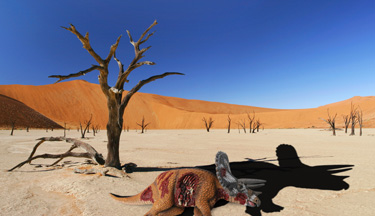 |
| Picture Credit: Everything Dinosaur |
Sixty-five million years ago, a massive asteroid slammed into Earth, causing tsunamis, earthquakes, fires, a global winter and the end of the age of the dinosaurs.
But what if the asteroid had glided safely past our planet? Would dinosaurs still be here today?
New research suggests the answer is probably not. Instead, scientists have found evidence that dinosaurs were in the midst of a long, slow decline that began millions of years before the asteroid struck. . . .
The authors are not sure what caused the speciation rate to slow down, but they have a few ideas. They explain that the Cretaceous period (145.5 million to 65.5 million years ago) was a time of drastic geological changes. The global climate was cooling down, there was prolonged volcanic activity and the continents were breaking apart.
Like I keep saying, environmental changes will do it every time.
Saturday, June 27, 2015
Saturday Science: I'm Not Making This Up
 |
| An artist's colour reconstruction of Hallucigenia sparsa is shown in this image released to Reuters on June 23, 2015. REUTERS/Danielle Dufault/Handout |
This is not an illustration for a science-fiction story. This creature, Hallucigenia sparsa, actually lived -- 508 million years ago. And after a fair amount (ahem) of research, scientists have finally figured out which end was which:
Hallucigenia, 0.4 to 2.2 inches long (10-55 mm), possessed seven pairs of nail-like spines protruding from its back, with an equal number of pairs of long, flimsy legs underneath tipped with claws. There were three pairs of skinny tentacles toward the head, perhaps used to process food or as antennae.
Hallucigenia has long baffled scientists. In the 1970s, it was thought its back spikes were legs, its legs were tentacles along its back and its head was its tail.
Keep in mind that we're dealing with a period in which Nature, so to speak, was being wildly experimental. Anything was possible -- until evolution cast the deciding vote. In this case, we're talking about an example of a group known as velvet worms, which are still around. As a group. Just not this particular one.
The universe is a strange and wonderful place.
Saturday, December 13, 2014
Saturday Science: Birds, Again
Interesting article at TPM this morning summarizing the results of a massive study of bird genomes. Starting at the beginning:
 |
| Reconstruction of Iberomesornis romerali |
Very early in the lineages leading to about 95 percent of today's birds, the researchers propose that a split happened some 68 million to 69 million years ago. One branch leads to doves, flamingoes and a few other species, while the other branch leads to basically everything else. That implies, for example, that flamingoes are more closely related to pigeons than they are to pelicans or other water birds.
A second split followed soon after, so that the resulting four lineages faced and survived the brutal extinction some 66 million years ago that's most famous for wiping out the dinosaurs, said Erich Jarvis of Duke University and the Howard Hughes Medical Institute, a lead author of the work.
I have to admit that birds fascinate me -- not that I'm about to become a bird-watcher, in the traditional sense. I just enjoy watching what they do and puzzling over their behavior, which is, as often as not, opaque. Maybe it's just that they are what's left of the dinosaurs, and who expects to understand why a dinosaur does what it does?
For some basic information on the evolution of birds, there's always Wikipedia.
Saturday, November 22, 2014
Saturday Science: The Evolution of Morality
I go on quite a bit about how human beings, as social animals, are more or less hard-wired toward what we call "moral behavior." As I usually phrase it, "Why do people form societies?" The answer, of course, is "For mutual benefit." (Actually, my usual answer is "I don't think it's so that the greediest and most dishonest can take everything," but that's usually when I'm debating "libertarians.")
Well, this morning I ran across this post from Undercover Blue at Hullabaloo, referencing this article by Indre Viskontas on the work of psychologist Paul Bloom. The article is not easy to excerpt, but click through -- it's short, and it has videos and stuff. Essentially, it summarizes Bloom's work with infants and toddlers on how compassion and a sense of fairness seem to be on display early on, based on babies' choices of the good guys (those who help or share) over the bad guys (those who do neither) as preferences -- they opt for the good guys.
This echoes the behavior of other primates exhibited both in research settings and in the wild: most of our relatives travel in groups, and they help each other out. Primate societies are marked by cooperation among the members, which from an evolutionary standpoint (you knew this was coming) has proven to be an adaptive trait: cooperation among members of the group enhances the survival of the group and, by extension, that of the individuals who make up the group.
There's always self-interest, though. In the realm of small children, Bloom discovered that, while perfectly happy to distribute someone else's treats in equal shares, when it comes to the child's own treats, it's a very different story. As they grow, however, that changes, as witness Viskontas' first anecdote in the article on Bloom's work:
There's an element of tribalism in this. As Bloom notes, as quoted by Undercover Blue:
And there we have an added wrinkle: culture building on inheritance.
(I don't think I need to emphasize how this applies to, say, contemporary American politics: it's a matter of expanding your perception of "Us" as opposed to "Them," and the trend in American history has always been toward a larger "Us." There's always been an element in American society, and others as well, that fails to make the leap. These days, we call them "Republicans.")
National Graphic did a special with Richard Leakey on his discoveries at Turkana in Africa, of which this clip addresses the issue under discussion here:
Self-interest? Yes, but also, as Leakey puts it, "bonding, care, love, affection, protection" -- which all boils down to "compassion."
If you look at any religion -- and most people, for some reason, consider the teachings of their religion as the basis of morality, rather than its codification -- you'll find that underlying all the codes of behavior, tribal taboos, and "history" is one basic precept: we take care of each other. (Some evoutionary theorists have hypothesized that we're also hard-wired for belief. Be interesting to see how they test that one.)
And I can already hear the objections: how can genetics determine something as complex as our understanding of morality? Well, in addition to instilling a tendency toward cooperation and compassion, evolution also gave us brains. You do the math.
(I'm going to refrain from commenting on the somewhat rudimentary sense of morality evidenced by the spokespersons of the "religious" right, except to note that their concern is with tribal taboos, not any real values. Although I will admit that imagining their reaction to the idea that morality is hard-wired gives me a great sense of satisfaction.)
This one has a lot of ramifications. Use your imagination.
Well, this morning I ran across this post from Undercover Blue at Hullabaloo, referencing this article by Indre Viskontas on the work of psychologist Paul Bloom. The article is not easy to excerpt, but click through -- it's short, and it has videos and stuff. Essentially, it summarizes Bloom's work with infants and toddlers on how compassion and a sense of fairness seem to be on display early on, based on babies' choices of the good guys (those who help or share) over the bad guys (those who do neither) as preferences -- they opt for the good guys.
This echoes the behavior of other primates exhibited both in research settings and in the wild: most of our relatives travel in groups, and they help each other out. Primate societies are marked by cooperation among the members, which from an evolutionary standpoint (you knew this was coming) has proven to be an adaptive trait: cooperation among members of the group enhances the survival of the group and, by extension, that of the individuals who make up the group.
There's always self-interest, though. In the realm of small children, Bloom discovered that, while perfectly happy to distribute someone else's treats in equal shares, when it comes to the child's own treats, it's a very different story. As they grow, however, that changes, as witness Viskontas' first anecdote in the article on Bloom's work:
At the playground, I watch my 10-month-old son beeline to the center of the sandbox where there is a bright pink shovel. But before he gets there, a rambunctious 2-year-old snatches up the coveted toy first. As my son watches the shovel slip away, a wobbly 14-month-old comes over and offers him a half-chewed cookie.
There's an element of tribalism in this. As Bloom notes, as quoted by Undercover Blue:
"But this compassion and this helping, it all pertains to the baby's own group," says Bloom. They are less naturally generous with out-group members.
By our natures, we strongly value those around us over strangers. And to the extent that you and I don't, to the extent that you and I might recognize that somebody suffering, I don't know, from the Ebola virus in Africa, is a life just as valuable as those of our closest friends and family, that's an extraordinary cultural accomplishment. And it's something that's not in the genes. It's not what we're born with.
And there we have an added wrinkle: culture building on inheritance.
(I don't think I need to emphasize how this applies to, say, contemporary American politics: it's a matter of expanding your perception of "Us" as opposed to "Them," and the trend in American history has always been toward a larger "Us." There's always been an element in American society, and others as well, that fails to make the leap. These days, we call them "Republicans.")
National Graphic did a special with Richard Leakey on his discoveries at Turkana in Africa, of which this clip addresses the issue under discussion here:
Self-interest? Yes, but also, as Leakey puts it, "bonding, care, love, affection, protection" -- which all boils down to "compassion."
If you look at any religion -- and most people, for some reason, consider the teachings of their religion as the basis of morality, rather than its codification -- you'll find that underlying all the codes of behavior, tribal taboos, and "history" is one basic precept: we take care of each other. (Some evoutionary theorists have hypothesized that we're also hard-wired for belief. Be interesting to see how they test that one.)
And I can already hear the objections: how can genetics determine something as complex as our understanding of morality? Well, in addition to instilling a tendency toward cooperation and compassion, evolution also gave us brains. You do the math.
(I'm going to refrain from commenting on the somewhat rudimentary sense of morality evidenced by the spokespersons of the "religious" right, except to note that their concern is with tribal taboos, not any real values. Although I will admit that imagining their reaction to the idea that morality is hard-wired gives me a great sense of satisfaction.)
This one has a lot of ramifications. Use your imagination.
Subscribe to:
Posts (Atom)