"Joy and pleasure are as real as pain and sorrow and one must learn what they have to teach. . . ." -- Sean Russell, from Gatherer of Clouds

"If you're not having fun, you're not doing it right." -- Helyn D. Goldenberg

"I love you and I'm not afraid." -- Evanescence, "My Last Breath"

“If I hear ‘not allowed’ much oftener,” said Sam, “I’m going to get angry.” -- J.R.R. Tolkien, from Lord of the Rings
Showing posts with label fantasy. Show all posts

Sunday, May 31, 2020

Review: Steven Brust: Brokedown Palace

Another Epinions orphan; another review of this book is at Green Man Review:

Brokedown Palace is another one of Steven Brust’s romps – I have to admit, the man astonishes me: from the highly individual noir detective cast of the Vlad Taltos novels to the delightful and affectionate take-off on Dumas in The Phoenix Guard and Five Hundred Years After, he has an amazing range and an astonishing amount of creativity. In this one, he’s done it with the traditional folk tale – not that this story owes much to any any particular tale, but Brust has taken the idea of folklore and the means and methods of folklore to make an engaging and fabulous – in the strict sense – novel

The universe is the same as that of the Vlad Taltos novels, in a different time and with a very different tone. Structurally, the story follows a more-or-less traditional narrative form, broken by interludes that may describe events that are important but of which the characters are unaware, or may simply be folktales (of the “tall tales” variety) within the larger folktale. The story is quite simple: it is the story of László, King of Fenario, who is not particularly sane, and his brothers, Andor, who is shallow and perhaps overly religious – at least sometimes; Vilmos, who is the archetypal giant, large, strong, gentle, and perhaps with a little more on the ball than others realize; and Miklós, the youngest, who is a little – well, more than a little stubborn, and more than a little outspoken. It is tempting to say that the Palace is another major character, but it’s not; it is, however a potent symbol that Brust uses to great effect. László has a tendency to try to beat Miklós to death, or nearly so, and is extremely sensitive about the condition of the Palace, which is tottering on its foundations – in this case, it’s called denial. After one nearly-fatal beating, Miklós exiles himself to the land of Faerie – in the Taltos cycle, Dragaera – where he learns Dragaeran sorcery (pre-Empire, needless to say) before his return to Fenario. We meet the táltos horse Bölk, a magical steed who is much more than he seems and always answers questions with more questions; the Countess Mariska, destined to wed László – or perhaps one should say resigned to the fact – and Brigitta, László’s mistress. There is a hidden villain, and a magical tree, and the Demon Goddess Varra, who has her own agenda.

And the whole thing is permeated by magic – not only the fantasy-world magic of spells and incantations, but the fairy-tale magic that says the unbelievable is real and is walking right next to you. In this novel, Brust displays a remarkable gift in combining irony, wit, and the innocence of childhood, in which the Palace, the River, a horse, a tree, all have their own purposes and their own ways of effecting their goals. As in folklore, the characters are broadly drawn, but this is a novel, and they accumulate the telling details that belong to real people as the story progresses – they are well-developed, but always hover in the realm of the archetype.

A word about the narrator, who encapsulates Brust’s various gifts in a highly entertaining way. The narrator is indeed a storyteller, who digresses (another of Brust’s many talents) to fill in the story, bring us details about the history of Fenario, the people and the land, and who provides a commentary that is sometime wry, sometimes matter-of-fact, but always lively and good-humored. But make no mistake – there are dark and terrible events in this story, as is necessarily the case if we are to be engaged at all, and as is very much the basis of folklore as it is of literature. Whether Brust’s stance makes them more terrible or more distanced is something that each reader, I think, will have to decide.

A final note: those who are more familiar with Eastern European folklore than I may derive an additional layer of enjoyment from this book. The vocabulary and I suspect the general tenor of the narrative seem solidly based in Hungarian language and Hungarian traditions (alright, Fenarian is Hungarian, or damned close), which brings an element of the exotic to the tale that just adds to the fun.

(Orb Books, 2006)


Monday, May 04, 2020

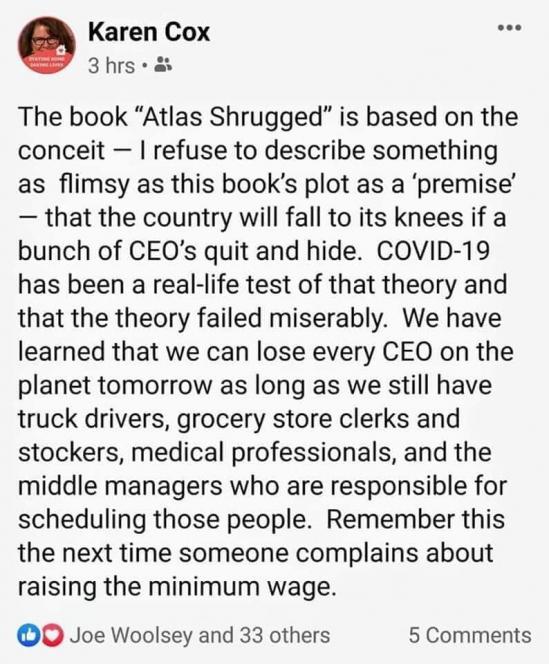
Thought For the Day

Think about who actually creates the wealth:

Thumbnail


With thanks to commenter KnownDonorDad at Joe.My.God.

Sunday, May 03, 2020

Review: Bill Willingham et al: Fables: Wolves

Wolves, the eighth collection of Bill Willingham's Fables, hits the title from several different directions, as well as bringing us into a story of black ops, missing persons, family reunions, and general, all-around intrigue.

Prince Charming, who may not be much of a mayor but is revealing himself to be a first-rate strategic thinker, has decided that it's time for the Fables of Fabletown to take the war back to the Adversary -- now that they know who and where he is. Unfortunately, a key player in PC's plan is missing: Bigby Wolf has taken off for parts unknown. Because of the cubs' shape-changing abilities, which they can't control very well, Snow White has taken them to live at the farm; Bigby, because of past history, is barred from setting foot on the place. Since he's no longer the Sheriff of Fabletown, Bigby has opted to get lost. Prince Charming has, however, the ideal Tourist to hunt him down: Mowgli, who himself was raised by wolves. The good Prince also has something to sweeten the deal for all concerned: Mowgli's reward will be the liberation of his old friend Bagheera from confinement, his sentence for his (unwilling) participation in the ill-fated revolution led by Goldilocks; and Bigby gets to be re-united with Snow and his family -- just how is a surprise. Key in all of this are another of the Prince's undercover agents, Cinderella, Jack's magic beans, and "the Israeli option," a matter of unacceptable consequences.

Along the way we learn that, in spite of his general fearsomeness, Bigby is not good with heights.

We've gotten back to a good, solid, complex story line in this one, with some good character building. Snow White, in particular, reveals new facets -- we see, in the way she deals with her somewhat unruly litter, including maintaining the fiction that their father is in touch via letters, the qualities that made her the very effective Deputy Mayor she was, but she's mellowed. Bigby, likewise, adds a couple of new dimensions, mostly involving his feelings for Snow. Mowgli is the prize here -- he's revealed as a dogged, resourceful tracker of lost Fables, and tough as nails when need be. (He's also about as pretty as it gets.)

There is one part of this story arc that stuck out, and at the risk of spoilery, here it is: Bigby and Snow get married, a huge, lavish affair, with all the Fables who can be found in attendance. Given the time of the original publication (2006), it's hard to think that Willingham is not making a political statement on the religious nature of marriage ("created by God"), which is hard to justify historically. And it doesn't really fit -- it's more than a little out of tune with the characters and the context -- neither Bigby nor Snow are really given to grand public gestures, and given the general spikiness of the characters in general, it's a just a little bit too transparently "feel-good."

There is a wonderful side story detailing Cinderella's work in negotiating the alliance between Fabletown and the Sky Kingdoms. Cinderella is just as prickly and impatient as they come, and as she informs Prince Charming in no uncertain terms, no more diplomatic assignments -- she's had it.

The art is up to the usual standard, and stylistically consistent throughout. This collection also contains maps of Fabletown and the Farm, and a script for issue #50.

(Vertigo, 2006) Collects Fables, #48-51.

Sunday, August 25, 2019

Review: Steven Brust: Brokedown Palace

Another Epinions orphan; I also reviewed this one at Green Man Review.

Brokedown Palace is another one of Steven Brust’s romps – I have to admit, the man astonishes me: from the highly individual noir detective cast of the Vlad Taltos novels to the delightful and affectionate take-off on Dumas in The Phoenix Guard and Five Hundred Years After, he has an amazing range and an astonishing amount of creativity. In this one, he’s done it with the traditional folk tale – not that this story owes much to any particular tale, but Brust has taken the idea of folklore and the means and methods of folklore to make an engaging and fabulous – in the strict sense – novel

The universe is the same as that of the Vlad Taltos novels, in a different time and with a very different tone. Structurally, the story follows a more-or-less traditional narrative form, broken by interludes that may describe events that are important but of which the characters are unaware, or may simply be folktales (of the “tall tales” variety) within the larger folktale. The story is quite simple: it is the story of László, King of Fenario, who is not particularly sane, and his brothers, Andor, who is shallow and perhaps overly religious – at least sometimes; Vilmos, who is the archetypal giant, large, strong, gentle, and perhaps with a little more on the ball than others realize; and Miklós, the youngest, who is a little – well, more than a little stubborn, and more than a little outspoken. It is tempting to say that the Palace is another major character, but it’s not; it is, however a potent symbol that Brust uses to great effect. László has a tendency to try to beat Miklós to death, or nearly so, and is extremely sensitive about the condition of the Palace, which is tottering on its foundations – in this case, it’s called denial. After one nearly-fatal beating, Miklós exiles himself to the land of Faerie – in the Taltos cycle, Dragaera – where he learns Dragaeran sorcery (pre-Empire, needless to say) before his return to Fenario. We meet the táltos horse Bölk, a magical steed who is much more than he seems and always answers questions with more questions; the Countess Mariska, destined to wed László – or perhaps one should say resigned to the fact – and Brigitta, László’s mistress. There is a hidden villain, and a magical tree, and the Demon Goddess Varra, who has her own agenda.

And the whole thing is permeated by magic – not only the fantasy-world magic of spells and incantations, but the fairy-tale magic that says the unbelievable is real and is walking right next to you. In this novel, Brust displays a remarkable gift in combining irony, wit, and the innocence of childhood, in which the Palace, the River, a horse, a tree, all have their own purposes and their own ways of effecting their goals. As in folklore, the characters are broadly drawn, but this is a novel, and they accumulate the telling details that belong to real people as the story progresses – they are well-developed, but always hover in the realm of the archetype.

A word about the narrator, who encapsulates Brust’s various gifts in a highly entertaining way. The narrator is indeed a storyteller, who digresses (another of Brust’s many talents) to fill in the story, bring us details about the history of Fenario, the people and the land, and who provides a commentary that is sometime wry, sometimes matter-of-fact, but always lively and good-humored. But make no mistake – there are dark and terrible events in this story, as is necessarily the case if we are to be engaged at all, and as is very much the basis of folklore as it is of literature. Whether Brust’s stance makes them more terrible or more distanced is something that each reader, I think, will have to decide.

A final note: those who are more familiar with Eastern European folklore than I may derive an additional layer of enjoyment from this book. The vocabulary and I suspect the general tenor of the narrative seem solidly based in Hungarian language and Hungarian traditions (alright, Fenarian is Hungarian, or damned close), which brings an element of the exotic to the tale that just adds to the fun.

Recommended? Absolutely.

(Ace Books, 1986)


Sunday, May 19, 2019

Review: Steven Brust: To Reign in Hell

Another Epinions orphan. There is another version at Green Man Review.

Fantasy literature as a genre seldom strays into the consideration of such literary criteria as "style." This is not to say that fantasy writers are generic – one can easily differentiate someone like C. J. Cherryh, with her lush, dense, highly colored prose and gift for dialogue from, for example, Charles de Lint, whose writing is equally lush, often equally dense, and just as captivating, but very different. But there are vanishingly few writers of fantasy who play with style the way Steven Brust does, and in Brust's hands, this means not only the quality and focus of his abilities as a wordsmith, but the assumption of style as a formal consideration that involves structure and theme. In Brokedown Palace, for example, he took the basic form and feel of a folktale and built a captivating novel of fantasy. The Taltos Cycle, a series of stories about a combination Nero Wolfe and Archie Goodwin (Vlad Taltos does a lot of the legwork and most of the thinking – he loves good food, but does not grow orchids) has a decidedly noir cast that brings it firmly into the camp of the classic American detective novel. His newest series, the Viscount of Adrilankha, began as an affectionate spoof of Alexandre Dumas in The Phoenix Guard and Five Hundred Years After. Throughout, Brust has displayed an ease and confidence that are truly awe-inspiring.

To Reign In Hell definitely fits the parameters. Brust's own idiosyncratic retelling of the War in Heaven and the casting down of Satan, it is in many ways a tribute to Roger Zelazny, with Dumas one of Brust's literary heroes. Zelazny wrote a glowing introduction to this book, and within a couple of paragraphs it is easy to see why he identified with it so strongly. Brust has used an episodic structure that is almost cinematic, borrowing devices that Zelazny made his own: the particular combinations of exposition and inference, direct narrative and ellipsis, become the literary equivalent of cuts and slow fades, moving the story along as though we were seeing it on the big screen. (If one has read such classic Zelazny as Creatures of Light and Darkness or his penultimate novel, Donnerjack, one can easily see the likeness.)

Brust also has a gift for characterization. His people are deftly and subtly drawn. Yaweh, in particular, moves from primus inter pares to omnipotent creator in a series of small, inevitable steps; far from being the all-knowing and all-powerful deity of Judaeo-Christian tradition, he is all too human, sometimes doubting his own rightness but ultimately acquiescing to what, he is told and comes to believe, is "necessary." This same subtlety and poignancy comes into play with most of the characters, and, while there is indeed a villain in the book, he is not the one the reader would expect – and even then, he can’t really be characterized as “evil,” merely ambitious and given to temporizing. In fact, there are really only a couple of characters who are not in some way sympathetic – the majority are all too human.

Perhaps not strangely in Brust's hands, this is not a story about "good" and "evil" – at least, not in our usual understanding of black/white, either/or, right/wrong – but is really a study of means and ends and the way that letting decisions make themselves is really a way of making decisions without the responsibility for their consequences. And, in this shades-of-gray viewpoint, integrity is not a marketable commodity. And so Satan, while trying to decide if he can wholeheartedly support Yaweh’s plan to create a completely safe realm for the inhabitants of Heaven (which is subject to periodic Waves from the surrounding flux, from which angels are created and by which they are destroyed while they battle to push the flux back outside their boundaries) in spite of its costs, is able to say to Yaweh: “I have never lied about who I was, what I was doing, or why I was doing it. You have done all of these.” Brust very neatly turns the traditional story and the traditional take on who are the heroes and villains on their heads. Both Yaweh and Satan are isolated, subject to counsel that is not necessarily bad in itself, but one-sided, leaving them vulnerable to the expectations generated by rumor on the one hand and the need for leadership on the other; the machinations of someone whose only guide is his own ambition provide the telling blow.

This is a book that can be read many ways, and there are many themes that reside in what is really a very concise, almost terse presentation of a age-old story: the ease with which we are corrupted by power, the easy perversion of sanctity by authority, the disease of fanaticism and its stomach for atrocities in the service of a "higher law,” the vulnerability of good will and tolerance. To Reign In Hell has that protean quality that is characteristic of all significant works of art – and I have no reservations about calling it just that.

Another point of comparison with Zelazny is that, while dealing with serious matters, both are known for the expert and almost surgically precise application of irony and a light touch. One senses the distance that each maintains from the heavy freight they are conveying, a stance that lets them set the issues out very clearly without ever letting them become ponderous.

The only complaint I have about To Reign In Hell seems to be built in: it's a known story, with a known outcome (although in Brust's hands, the means are something of a surprise), and even in this rendering, this known outcome is the logical outgrowth of character and events. The result from the reader's standpoint is that the climax is more than a little anticlimactic. Even with all the givens, I really had hoped for something a little grander, even while realizing that would have subverted and cheapened the book.

I don't mean, by all these comparisons with other writers, to imply that Brust is in any way lacking. Indeed, as I have read more of his work, I have come to realize that he is undoubtedly one of the finest writers in fantasy today. Even a relatively early novel such as this one (it was originally published in 1984) has a maturity and depth that many writers never achieve. I think it's axiomatic that an author can only be successful at parody if he is operating from a strong base of his own, and Brust seems to prove my point.

(Tom Doherty Associates; originally published by SteelDragon Press, 1984)

Sunday, April 28, 2019

Review: Emma Bull: Bone Dance

Another foundling from the late, great Epinions.

A good argument can be made for calling Emma Bull’s Bone Dance an urban fantasy. There is a great deal to do with the spirit world, events that are only explainable in terms of magic of some sort, and there are visitations from supernatural beings. However, the fact that it is set in a post-Apocalyptic dystopia, technology plays a pivotal role (although that is more because of its scarcity than because of its reliability), and the magic comes from “hoodoo” (Voudou is part of modern reality, for some of us at least) make me place it firmly in science fiction (which does, after all, leave room for beings with advanced mental powers).

Sparrow is the narrator, leading us through the maze of the City (which is only the City, no other name; it could, perhaps, be Minneapolis, Bull’s hometown, although a couple of references seem to place it south of The Border) a few decades after someone pushed the Button. The history is unclear, which doesn’t really matter – the damage was done, and what we must deal with is now. Life in Sparrow’s City runs on the Deal – money is hard or soft, favors are owed one way or the other, and that is the basis of trade. Sparrow is an electronics expert (although the explanation for this comes not until midway through the story) who runs a black market in old videotapes and sound recordings – black market because most of the information from before the Bang is subject to seizure and destruction by whatever authority there may be. In this case, the authority is A. A. Albrecht, who holds a monopoly on energy in the City proper. He is also one of Sparrow’s best customers for old movies, especially originals (as opposed to dupes), which bring very high prices. One of Sparrow’s haunts is the Night Market, where goods of all sorts are available from dusk until dawn; another is the Underbridge, a dance and video club of which Sparrow is one of the operators. Sparrow also has blackouts – periods of varying length that leave no memories, although Sparrow’s absence is apparently not obvious. Into this mix comes Frances, who, as it turns out, is one of the legendary and hated Horsemen, secret military weapons who could take over the bodies of others. It was the Horsemen who pushed the Button; Frances is on her way to kill Tom Worecski, who put together the plot to rain nuclear death on the Western Hemisphere and duped Frances and other of the Horsemen into participating. Mick Skinner is another who comes into Sparrow’s ken, seemingly briefly, since we discover that he has been dead since before they met. Events conspire to draw Sparrow into Frances’ search for Tom, and the interlocking relationships – Sherrea, perhaps Sparrow’s closest friend, who is a talented card reader; Theo, one of the other operators of Underbridge, who has a surprising relationship to Albrecht; Cassidy, who is setting himself up to be a victim; and Dana, who has connections – provide a fair measure of suspense.

I don’t really know what to compare this book to in order to give you some touchstones – perhaps Dhalgren meets The Maltese Falcon. The environment is near-hallucinatory, the more so because the main lighting seems to be neon (the Night Market is, after all, the Night Market). The context is very rich and detailed. Sparrow’s blackouts begin to intercut with hallucinations, involving stick figures who pass on cryptic messages; one of them is definitely Kokopelli, the trickster-hero of the ancient American Southwest, who speaks in lines from movies; another is, perhaps, Oya Iansa, who governs wind and the lightning and brings change.

Sparrow is a true anti-hero. Many of the surprises in the book come from the fact that Sparrow has an obsession about privacy, and is consequently not terribly perceptive of the details of others’ lives, even when those details are available. The reason for Sparrow’s privacy fetish is unveiled halfway through the book, along with revelations about the Horsemen: Sparrow, it turns out . . . no, I don’t think I’ll tell.

Bull is one of those writers who can pull you into a context with no effort. As hallucinatory and distasteful as this world is, you are there, and you go willingly. Her prose is tight and lucid, particularly when she is writing about the supernormal, which only makes it more real. Voudou and the Tarot form a major part of the foundation for this story, along with the key plot issue, which is energy as the operative force of the universe. Bull’s treatment of this reminds me of the philosophy of the creators of the original Whole Earth Catalogue, which was one of my touchstones during the 1970s – if energy keeps the universe turning, anything that has the potential to block the flow – like money, or too much power in too few hands (which seems to have become the same thing) – needs to be dealt with very carefully, and sometimes very forcefully.

“Coming of age” has a multitude of meanings, and it’s a type of story that I seem to have been running into a lot lately. Maybe that’s because every work of fiction is about coming of age in some sense. We move from childhood to adolescence to adulthood to maturity, and not all parts of us make the progression at the same rate. Bone Dance is a coming-of-age story as much as anything else; and Bull uses it to explore one other thing that I want to note: how our perceptions of what others’ perceptions are or might be color our reactions – often before there is anything to react to. It’s also an object lesson in how opening ourselves to the wider world – the next stage of our lives – is often costly and hurtful, but necessary unless we are to give up our responsibility as human beings to be human beings.

This is a terrific book.

(Ace Books, 1991)


Sunday, April 07, 2019

Review: Harold Zwart: Mortal Instruments: City of Bones

I have to confess, I went to see Mortal Instruments: City of Bones simply because I had seen a big display at my second favorite theater. It opened at my favorite theater (close, cheap), so I went. I liked it well enough that when I ran across the DVD at the right price, I bought it.

Clary Fray (Lily Collins) is having a birthday. To celebrate, she goes out with her best friend, Simon (Robert Sheehan) to a poetry reading. As an antidote, she insists that they stop at a club afterward – because she saw a symbol on its sign that just like the symbol she’s been drawing. Strangely enough, no one else can see it. And somehow, she and Simon don’t really fit in, which becomes fairly obvious when she witnesses a murder that no one else sees – not even Simon. When she comes home one day to discover the apartment she shares with her mother, Jocelyn (Lena Headey) a sea of wreckage and said mother missing, she doesn’t quite know what to do, especially when she’s attacked by a pair of thugs and rescued in the nick of time by – the man who committed the murder she witnessed, Jace Wayland (Jamie Campbell Bower). From the fact that she can see him, he surmises that she is not a “mundane” – that is, human. She’s a Shadow Hunter, from a long line of Shadow Hunters, and she holds a secret that everyone is after – the whereabouts of a Chalice that enables the Shadow Hunters to survive. The problem is, she has no idea what it is or where it is. And it’s essential that it be found: the Shadow Hunters protect the world from demons, and without Shadow Hunters . . . well, you can guess.

Basically, this is a classic coming of age story – Clary first of all has to learn what she is and what she can do, and then how to do it. Add in werewolves, led by her mother’s sort-of boyfriend, Luke (Aidan Turner), and a mad Shadow Hunter, Valentine (Jonathan Rhys Meyers), who claims to be not only Clary’s father, but Jace’s, assorted demons, and the Portal, which can transport a Shadow Hunter to anywhere he or she can visualize clearly, and you have the makings of an engaging and action-packed adventure story on top of it.

And it works. I went into this one cold – not only was I not a fan of the books, I wasn’t even aware that they existed – so I was saved from premonitions of another Twilight. I admit, I was not riveted by Collins’ performance on first viewing – flashbacks to Kristen Stewart in Snow White and the Huntsman – but after seeing it a second time, I chalk that up to the meds my doctor has me on. I would have liked a bit more clarity in her growth into her powers, but I suspect the script is more than a little responsible for that – there’s doesn’t seem to be a lot of room for subtext here, which is a shame, because it affects all the characters. Bower is engaging as Jace, but somehow remote, whilte Sheehan is more than appealing as Simon, in good part because he’s really the only one who lets us into his head.

The effects are persuasive, and although the pacing is given to fits and starts, the acting is capable enough to carry it as an action/adventure quasi-horror flick.

And yet, it’s not that strong a film, largely because of that lack of subtext: the story’s engaging, the visuals are sometimes riveting, the characters are sympathetic, but when it was all over, I just said, “Well, that was nice” and went on to the next activity. It doesn’t really have the depth to stick with you.

Rated PG-13, running time 130 minutes.

(Constantin Film, Unique Features, Mister Smith Entertainment, Mr. Smith Productions, 2013)


Sunday, December 16, 2018

Review: Camille Bacon-Smith: Eye of the Daemon

Camille Bacon-Smith is a folklorist and author who has written, in addition to her four novels, several books and articles about popular culture. Eye of the Daemon is the first book in the “Daemons, Inc.” series, about Kevin Bradley, known as Brad, a private investigator who is actually the demon Badad; Evan Davis, his half-human son; and Lily Ryan, their partner and Evan’s lover, who is the demon Lirion.

Bacon-Smith’s background for the daemons and their relationship to humans is set up as a series of forewords to each chapter, which explain the seven spheres of creation and read as though they were taken from the Qabbala; the Princes, each composed of a quorum of daemons, occupy the Second Sphere, in which only space exists; Badad and Lirion are lords of the Prince Ariton. Earth and humanity occupy the First Sphere, which contains both space and time – hence, mortality. We learn, in the course of the story, that Evan, as a daemon halfling, is a wild-card, a being of immense power who works in both time and space. By the mere fact of his existence, he could cause the destruction all seven spheres; other halflings have been insane, and either killed themselves or been killed early in their lives, and so have never posed the threat that Evan does. Evan has had his own bit of hell to live through, centered around a club in New York called the Black Masque, run by the demon Omage, which figures in the present tale. He was rescued by his father, who, given the choice of destroying Evan or taking responsibility for him and allowing him to live, chose the latter. He is at a loss to explain his motives, except perhaps that he has spent too much time in human form, and the “meat thinking” starts to take over. Badad and Lirion have also been, in essence, exiled to the material plane to keep Evan under control until his natural death as the price of his life. Kevin has taught his son to control his wanderings between the planes. The reader also begins to become aware of anomalies in the natural world that seem to be tied to Evan’s moods.

The firm of Bradley, Ryan and Davis specializes in cases requiring a great deal of discretion – recovery of stolen art, for example. They are distinctly high-end. The story begins when Marnie Simpson, a wealthy horse-breeder, comes to Bradley, Ryan and Davis about her missing brother. He has been kidnapped, and the ransom note – burned into the top of her dining-room table – leaves no doubt that the case is one for Kevin Bradley: the note demands the return of the “Eye of Omage,” or her brother will spend eternity wishing for death, and specifies the firm of Bradley, Ryan and Davis as the ones to handle the exchange. Omage is a lord of the Prince Azmod, a rival prince to Ariton – or, to the daemon way of thinking, Asmod never makes alliances with Ariton -- and an enemy especially to Badad, since Omage is the daemon who almost destroyed Evan. After Evan’s initial research turns up some surprising connections between Marnie Simpson, her husband Franklin, and the Black Masque, Kevin and Lily decide that they will handle the case; Evan is overdue for a vacation, so he will spend some time in Europe, relaxing.

Early on, it becomes apparent that this case is a trap, but who is the target? The Eye of Omage, it appears, is a large topaz that Lily had brought back from Venice with the stolen Picasso, and for which Evan feels a strange affinity. Evan, staying with his friends in London, Claudia and Jack Laurence, friends from the Black Masque days, runs into the client for whom they had recovered the Picasso, Charles St. George, in a small bookstore in which Claudia works, and the three have dinner together. The next day, Kevin is visited by another daemon lord of Azmod, Pathet, who burns Jack to a cinder and tries to implicate Evan in the murder. Within the hour, the bookstore in which Claudia works is firebombed and she is kidnapped.

This is a fair mystery story, with its share of plot twists and revelations – no one is telling the truth, no one is who they seem to be. It is even more a story that explores the mysteries of relationships between sons and fathers, in the persons of Badad and Evan. Do generations ever really understand each other, even without the twist of a daemon father? Mature men are in authority, and there is always that tension between mature man and young man, who needs to move into his own power, his own independence. Even, as in this case, when father says, simply, “It’s up to you,” there is the question, “Will he save me this time?” in balance with the question “Can I do this alone?” Evan, after surviving the nightmares of his childhood and the nightmare of his early manhood, has a father who is a daemon, and is, at least in theory, as incapable of feeling love as he is of understanding death – and how many of us have felt that way about our fathers?

Evan is a damaged man – he had been well beyond the bounds of sanity when found by his father, and even with the healing he has managed, he still suffers from exaggerated feelings of guilt and inadequacy. Evan’s feeling of guilt sometimes come very close to getting in the way of the story; Kevin’s ruminations about his feeling for this son, on the other hand, are illuminating. (It would seem that the daemon Badad, having spent so long in human form, has fallen prey to the human propensity to wonder “Why?”). Lily, by contrast, is very direct, almost elemental; she never bothers to worry about her feelings for Evan, if any – she calls him “monster” and her “toy.”

About binding daemons: Bacon-Smith has set up a strong contrast between the bindings under which Pathet and Omage are held, based on greed and the desire for power, and the binding that Evan places on Badad and Lirion, proposed and agreed to purely as a means to protect them from whoever is controlling the lords of Azmod – they understand the danger to Badad and Lirion early on. This contrast opens up another, tangent question: the impossible tangle of human motivations, particularly our capacity for self-sacrifice, which is incomprehensible to daemon-kind – humans barely understand it themselves. The final confrontation is intense – Evan is held in check only by his humanity – and is actually two confrontations: Evan has to deal not only with the daemons Omage and Pathet and their human captors, but Count Alfredo da Costa – art thief and something more – whose duty at this point is to kill him. (Da Costa’s character, which comes into prominence only at the end of the book, never really gels – he has a duty, but manages to drag out the execution of it long enough to give Evan the chance to defy him.)

Bacon-Smith has made an absorbing story, although it suffers from a little bit too much self-examination on Evan’s part; its sequel, Eyes of the Empress is better in this regard. She is, however, a good writer, with a unique presentation of daemon’s in a modern urban fantasy.

(DAW Books, 1996)


Sunday, October 07, 2018

Review: Glen Cook: Sweet Silver Blues

If you follow Green Man Review, you'll know that I've reviewed a lot of Glen Cook -- or his heroic fantasy series, at least. This is one from Epinions that I didn't review there, and it's not heroic fantasy.

Garrett, P.I. possibly rivals Glen Cook's The Black Company as his most popular series. I can tell because, Sweet Silver Blues, the first book, has been showing up in bookstores again. (I mean, places where they sell new books.)

This is the book in which we are introduced to Garrett, a down at the heels private eye with an attitude problem, and the dazzling city of TunFaire, along with some of the ongoing characters in the story: Morley Dotes, the half-breed dark elf, who is as fast and nasty as they come; the delectable Tinnie Tate, a diminutive package of sharp-edged redhead; Saucerhead Tharpe, a man of great integrity if not such great intelligence; Playmate, one of the rare honest citizens of the city; and, certainly not least, the Dead Man, Garrett's silent partner.

Denny Tate, one of Garrett's old army buddies (not really -- their acquaintance began after their military service, but that description will do as well as any) has died, and the family wants Garrett to find the main beneficiary of Denny's will. She is, as it turns out, a woman with whom Garrett himself had been involved, who lives in the Cantard, where the war against the Venageti has been happening and which is not a place Garrett wants to have any new memories of. As it happens, the time seems right for Morley to accompany him (a little matter of some overdue . . . bills), and the Tates make the money right for Garrett to consider it. When they set out, Tinnie and her cousin Rose offer some complications; there's also a mysterious yacht that paces them down the river, first to Leifmold and then to Full Harbor, the main port of the Cantard. They somehow arrive safely, only to confront a series of puzzles.

Of course, it goes downhill from there.

The fantasy detective story is one that goes way back. The modern versions start, perhaps, with Randall Garrett's Lord D'Arcy stories, and continue through Steven Brust's Taltos Cycle, Tanya Huff's Blood series, and Jim Butcher's Dresden Files, among others. Cook plays it for comedy, if you can imagine such a thing. The series overall is almost classic Rex Stout, with Garrett playing the long-suffering Archie Goodwin and the Dead Man as the peremptory Nero Wolfe. The characters are among the more bizarre in fantasy, the dialogue is sharp and earthy, the narrative fast and fluent, and the puzzles are pretty much impenetrable.

An interesting part of Sweet Silver Blues is what Cook has done with some of the regulation denizens of fantasy universes: unicorns are pack hunters using trained dogs to help them find prey, and the vampires are really repulsive and really scary. Of the Other Races, as Cook christens them, there has been (and probably continues to be) a great deal of intermixing -- hence the Tates, who have faery in their blood, and Morley Dotes and his henchmen, Doris, Marsha, and Dojango Roze (triplets with different mothers), distantly related to Morley -- and also to trolls and it's hard to know what else.

I enjoyed it immensely (full disclosure: although I can't really consider myself a "fan" of any writer, Cook comes close). The narrative flow is smoother than some of his other books (most noticeably The Instrumentalities of the Night and some of the Black Company books) and very tight, which I always appreciate. There is a little bit of a sense of getting a handle on the universe in this one, but only just barely. By a second reading (and it does hold up that well), you will swear you imagined it.

In-group thing: Fans of Glen Cook will have noticed his tendency to work the titles of his previous books into later ones -- not set off as titles, but just as a normal part of the narrative. This one's no different -- keep an eye out for references to the Dread Empire series.

(Ace, 1990)


Sunday, July 22, 2018

Review: Aquaplus and Toyuki Kobayashi: Utawarerumono

Another originally published at Epinions and no longer available there.

It took me a couple of weeks to learn to pronounce the title of this series, Utawarerumono, but I was determined. It was another find on a recommendation by my manga expert, and it's a good one. (The title is translated as "He Whose Song is Sung" -- in Japan, just as anywhere else, if people sing songs about you, you're in.)

A severely wounded man wearing a half-mask is found in the woods by a girl, Eluluu, grandaughter of the village healer, Tuskuru, who also happens to be the chief. They nurse him back to health, but he has no memory of who he is or where he came from. He is soon accepted by the villagers and shows himself to be a natural leader. When Tuskuru is killed defending her other granddaughter, Aruruu, from one of the local lord's soldiers, the villagers select the man, who has been given the name Hakuoro, as their new chief. And when they decide that the death of Tuskuru cannot go unavenged, they, and Hakuoro, are set irrevocably on the path of empire. And as he goes, he collects a strong -- and more than a little eccentric -- group of heroes around him.

This is sort of an odd story. We eventually learn that it actually takes place in the far future, although the setting is fantasy-feudal, Japanese style, give or take the bipedal dinosaurs that are the main riding animal. And everyone has animal ears, and women and girls also have tails. Everyone except Hakuoro, that is. The reasons for that are revealed well into the series, and I don't want to give them away here: it's a nice little "Aha!" moment.

We also learn that Hakuoro is not exactly human, and that he shares a soul with someone who has become, behind the scenes, his worst enemy. That leads to a spectacular final battle and a poignant, bittersweet finish.

Speaking of enemies, one flaw in the story is that the bad guys -- and there are a series if them -- get crazier and crazier, until they turn into caricatures. Actually, it doesn't really take very long for that to happen -- the first really seriously bad guy, Niwe, has perhaps the most irritating villain laugh ever.

The graphic work is good, if not spectacularly so -- characterizations are solid, action sequences are smooth, and the general level of the animation is pretty high. One thing I did notice, which still puzzles me: the major characters fit into a sort of manga-standard template, with triangular faces, retrousse noses, pointed chins, small mouths, and large eyes -- sort of High Shoujo characterizations. Even Haruoko fits into that mold, and it's to the animators' credit that he is as visually expressive as he is -- remember, he's wearing a half-mask throughout. The other half of the puzzle is that the secondary characters are strongly individual and much more "realistic" insofar as a cartoon can be. It works, though.

The acting, as tends to be the case in anime, is very good, although it did take me awhile to get used to some of the voices. Half the central characters are girls, and young girls at that: the voices sometimes approach hypersonic ranges. Special mention to Rikiya Koyama as Hakuoro: he doesn't say much, but when he does, it's nearly perfect. This must have been an extraordinarily difficult role in which to develop a full character, but Koyama pulled it off.

I can't really explain why I find Utawarerumono so appealing. It's not perfect, by any means, but it is tremendously engaging -- another one that I found myself watching seven or eight episodes at a stretch. If it weren't for the violence -- and it's there, in many battle scenes with lots of bright red blood -- I'd recommend this as nice family viewing. There are many quietly humorous moments that project warmth and comfort, and the message is one of peace and doing the right thing. Even though there are a lot of battles, the message there is that war is only justified in self-defense and even in that case, one is stained by bloodshed.

(Funimation, 2009)


Sunday, June 24, 2018

Just What We Needed -- Another Arms Race

And you don't think that will be the end result of this idea?

President Trump’s surprise decision to order the creation of a U.S. “Space Force” came because he was frustrated with Pentagon officials for not taking up his initial suggestion, The Wall Street Journal reported Friday.

Trump directed the Defense Department on Monday to create the country’s sixth military service branch, a move that shocked Pentagon officials and lawmakers.

People familiar with the decision told the Journal that Trump often throws out ideas in public but then expects his aides and Cabinet officials to create follow-through plans.

Trump gets frustrated and make demands when he feels like his appointees haven’t jumped into action, the newspaper reported.

“He doesn’t forget, and ultimately erupts when he feels slighted,” a former high-level industry and government official said.

And he very easily feels slighted.

So we're going to wind up spending a lot of money and throwing the Pentagon into further chaos because Fearless Leader wants to play space cowboy. And of course, the Russians and Chinese and Europeans will have to follow suit, because, thanks to The Donald, they're all unfriendly powers now and our developing a space force is a threat to their national security. And we have to have a space force because you can't bully someone without something to back it up.

Via Digby.

Sunday, June 03, 2018

Review: David Petersen: Mouse Guard: Fall 1152

Another from the late lamented Epinions. I actually discovered this book from a review at Green Man Review. (Yes, I do occasionally read reviews, especially when I have to edit them.)

After the Winter War of 1149, when the Mouse Guard threw off the yoke of the Weasel Warlord, the mouse cities in the forest were able to live in relative peace -- as much peace as mice can find, at any rate. The Guard, under the captaincy of Gwendolyn, maintains the safety of the trade roads and protects the farmers and merchants. One merchant has gone mssing -- he and his grain cart never reached Barkstone. Three of the Guard's finest, Kenzie, Saxon, and Lieam, are sent to rescue him. They discover his cart and, after dispatching a snake that attacks them, discover the merchant -- pretty thoroughly digested, by this point. They also discover among his effects a map of Lockhaven, the Guard's stronghold, the sort of thing that is kept under lock and key and is never to leave the fortress town: their merchant was a traitor, but in league with who?

This one is a delight, from the mice -- real mice, with tiny little pink toes and beady little eyes, not disneyfied in the least -- to the absorbing story -- an action/thriller if there ever was one -- to the wonderful graphics work. Where to start?

The story is a good one, tight and well planned, with mouse-heroics galore, treachery, a night march on Lockhaven, leaders plotting strategy, and even horrendous monsters. The characters are vividly drawn -- Lieam, a new recruit but a hero nevertheless, is a prize -- while Gwendolyn is the very picture of a commander with a major mess on her doorstep, and the context is well thought out and beautifully executed.

The drawing is just wonderful. What he can't show in facial expressions -- and let's be honest, mouse physiognomy doesn't leave a lot of room here -- Petersen conveys in body language, and the mice actually look like mice. (Sorry -- that still just blows me away.) The pages are beautiful -- the drawing is better than good, the colors -- mostly in warm tones, browns and golds and coppers and siennas and umbers, with just the right touches of blue and green and gray -- are perfect, and layouts, while pretty regular, set up some good rhythms through Petersen's formal sophistication -- things like two-page spreads in which one page mirrors the layout of the other, and then suddenly you hit a spread that is all one scene. It sets up a nice flow for the story, very clear and intelligible. (A note: looking through again, I'm struck by the way Petersen manages to blend realism and formal abstraction in the same scenes -- it makes for very rich, strong images and doesn't really call attention to itself.)

There's not a lot else to say -- in its most important aspects, the book is simply indescribable. You really have to see it. In fact, I highly recommend that you do.

(Archaia Entertainment, 2009)


Wednesday, January 24, 2018

In Memoriam

Ursula K. LeGuin, 1929-2018:

Photo:  Wikimedia Commons
Acclaimed science-fiction author Ursula K. Le Guin died Monday in her hometown of Portland, Ore., her agent confirmed. Le Guin was 88.

Although best known for her science fiction — particularly the Earthsea series — Le Guin was a creative, curious writer whose more than two dozen books encompassed fiction, poetry, essays, criticism, children's books, works of translation, fantasy and even blogging.

Oddly enough, I've only reviewed one of LeGuin's books ,Gifts, which review is not available right now but will be showing up at Green Man Review sometime in the (relatively) near future. I did include her in a series of essays on sexual identity in science fiction, which, alas, is no longer available online and seems to be missing from my files. She was one of the science fiction/fantasy writers of the 1970s and '80s who redrew the map, so to speak, on what was permissible in the genre in terms of sex and gender. The Left Hand of Darkness was one of the ground-breakers in that regard; if you've never read it, hunt up a copy.

I didn't agree with her statement that genre was a marketing tool for publishers; there's a lot more to genre fiction than that, in that each genre has its own tropes and its own landscape, so to speak.

At any rate, there are some people who should live forever. LeGuin was one of them.


Thursday, October 26, 2017

An Important Message from Peter S. Beagle

Those of you who are familiar with fantasy literature -- and perhaps even those of you who are not -- will recognize the name of Peter S. Beagle, author of some of the most memorable works in the genre, starting with A Fine and Private Place. Beagle is currently suing his former manager and business partner, Conor Cochran. Now, Cochran is claiming co-authorship of Beagle's work. Peter has a statement on the subject which you can read here.

I urge you to do so.

Sunday, January 29, 2017

Wha's New at Green Man Review

It's that time of week again, and there's some interesting stuff, mostly centered on London -- as it is, was, or might have been. Click through to see what I mean.

Oh, and there was a story this week, too.

Sunday, January 22, 2017

What's New at Green Man Review

Yes, it's Sunday, and that means reviews. Lots of interesting stuff, if I do say so myself, so scoot on over.

Sunday, January 08, 2017

What's New at Green Man Review

Something old, something new. . . .

As seems usually to be the case there. Hop on over and take a look at what we've got today.

Sunday, December 04, 2016

What's New at Green Man Review


Lots of fun stuff today -- great books, wild music, and chocolate! So scoot on over.

Sunday, November 20, 2016

What's New at Green Man Review

Yes, it's Sunday again, with more goodies at Green Man Review, including a new music review from me and a couple of fantasy/science fiction trilogies that were pretty damned good.

So click on through.

Sunday, July 17, 2016

It's Sunday -- You Know What That Means

It's "What's New" day at Green Man Review, and so there are more reviews published.

You know what to do.