"Joy and pleasure are as real as pain and sorrow and one must learn what they have to teach. . . ." -- Sean Russell, from Gatherer of Clouds

"If you're not having fun, you're not doing it right." -- Helyn D. Goldenberg

"I love you and I'm not afraid." -- Evanescence, "My Last Breath"

“If I hear ‘not allowed’ much oftener,” said Sam, “I’m going to get angry.” -- J.R.R. Tolkien, from Lord of the Rings
Showing posts with label geology. Show all posts

Saturday, February 03, 2018

Saturday Science: Wanderers

No, I'm not talking about comets or dessert nomads or the like, this is about continents. We tend to think of continental drift, if we think of it at all, as a slow, stately dance that follows a regular pattern. What we tend to forget is that the driving force, the convenction currents in the earth's mantle, change strength and direction -- they're no more permanent than anything else in the universe. For example, we're used to thinking of the configuration of continents as it exists now as sort of the template for the way it always was. Except that the breakup of Pangaea happened about 175 million years ago, and this sort of thing -- the continents moving around, joining and splitting, has been going on for over 3 billion years.

So we really shouldn't be surprised when geologists discover something like this:

Curtin University researchers have discovered rocks in northern Queensland that bear striking similarities to those found in North America, suggesting that part of northern Australia was actually part of North America 1.7 billion years ago.

The research paper in GEOLOGY published by the Geological Society of America, concluded that the rocks found in Georgetown, 412 kilometres west of Cairns, have signatures that are unknown in Australia and instead have a surprising resemblance to rocks found in Canada today.

Curtin University PhD student Adam Nordsvan from the School of Earth and Planetary Sciences said the findings were significant as they unlock important information about the 1.6 billion year old supercontinent Nuna.

“Our research shows that about 1.7 billion years ago, Georgetown rocks were deposited into a shallow sea when the region was part of North America. Georgetown then broke away from North America and collided with the Mount Isa region of northern Australia around 100 million years later,” Mr Nordsvan said.

“This was a critical part of global continental reorganisation when almost all continents on Earth assembled to form the supercontinent called Nuna.

So Pangaea was not the first supercontinent, by a long shot.

The article at the link is fairly brief but also interesting, and has a link to the full paper (which you can purchase if you're really interested).

Saturday, September 02, 2017

Saturday Science: Some Stray Thoughts on Geology

I'm not sure how I got on this train of thought, but I found myself thinking about the geology of Illinois. Most of the state is a huge syncline, which is to say a big bowl, full of dirt.

The northern part of the state, around Chicago and across to Rockford, is glacial moraine (no real surprise, since northern Illinois marks the southernmost reach of the glaciers in mid-America, as witness the southern shore of Lake Michigan, which, along with the other Great Lakes, was formed by glaciers), while in the far south, you can, if you look at the right places, see the folding and distortion that is the result of the mountain building that created the Appalachians, some 300 million years ago (although some sources place that even as beginning 480 mya -- but that may depend on what part of the Appalachians you're talking about), when what is now North America collided with Gondwana (present-day Africa and South America).

And yes, the effects of that collision are visible in southern Illinois, hundreds of miles to the west.

And do check out the link -- it's kind of long, but very interesting, and pretty much tells the whole story, starting about 750 million years ago.

This helps in visualizing the whole thing:


And this is the sort of thing I think about when I allow my mind to wander.

Sunday, September 11, 2016

Saturday Science: Earth: A Biography: Land, Ho!

I know, it's Sunday, but at least I got this part finished.
I haven't spent a lot of time discussing what was happening to the Earth itself during these couple of billions of years during which life was getting itself on the map, so to speak. You'll remember that at the beginning of this time, during the later Hadean, there wasn't a whole lot of land. What land existed was barren (of course) and probably pretty unstable. About four billion years ago, we're probably looking at a world map something like the image on the left.

Now, at least one geologist has doubts as to whether we can actually call these landmasses from four billions years ago "continents."

As John Rogers sees it, three billion years is as far back as you can go in studying continents. Before that, they didn’t exist - not by his definition.

Traditionally, geologists determined the age of a continent based on the oldest exposed rock, which is some variety of granite. Because granites constitute the foundations of continents, geologists assumed that any granite found must date back to the continent’s formation. But Rogers, Kenan professor of geology, pointed out that granites were forming and being reworked into the crust before the crust was steady enough to sustain a continent.

“I kept saying that a whole pile of granites that is continually being destroyed is not a continent,” Rogers says. “It’s just a temporary pile of rock.”

He bases part of his argument on the ages of various parts of Pangaea, and it's worth looking at, but since Pangaea is much later than the period we're dealing with here, I'm not going to concern myself with it. What I am going to be looking at is a couple of processes involved in land formation.

Now, it may seem like a no-brainer, but it comes as a surprise to a lot of people to realize that one of the first natural phenomena on Earth, after the formation of what we'll call proto-continents, was rivers. Think about it: you have a hot planet that's cooling down, an atmosphere with a lot of water vapor, and a lot of variation in elevation: there's no reason to suppose that the earth's surface was flat, given that land formation was largely the product of volcanic activity: think Mt. St. Helens, or Vesuvius, or, for that matter, the Hawaiian Islands.

So, it starts raining. And raining. And raining. (Sorry, but forty days and forty nights isn't even in the running.) Two things are going to happen. The low places are going to fill up with water, and the water that falls on the higher places is going to run down to the lower places -- that is, we have rivers. And with rivers come sediments.

There are a number of contributing factors to erosion during this period. First, there's the action of rain itself, which, given the composition of the atmosphere -- carbon dioxide, water vapor, methane, and probably sulfides and other fairly corrosive compounds -- was more than likely, acid. While the rocks that existed were fairly resistant -- it's not easy to erode granite or basalt -- the acid rains had some effect. There is also evidence of glaciation as early as 2.9 billion years ago, and if there's one thing glaciers can do with great efficiency, it's erode rock.

So we have rivers, and we have sediment, and one thing that happens with sediment is that, as the rivers reach lower ground and slow down, the sediment drops out. This is especially true when the rivers reach the ocean. So we have sediments deposited in lowlands and in shallow oceans near rivers that are just waiting to become, in the first instance, soil, and in the second, rock.

(A fuller discussion of the climate and general conditions in the Pre-Cambrian can be found in the Encyclopedia Britannica. It's exhaustive, and a little dense in place, so be warned.)

I'm still trying to pin down a point of origin for the critters that first developed exoskeletons -- not trilobites or crinoids, those are much too late, but the little prokaryotes that might have accreted shells of calcium carbonate to reinforce their cell membranes and/or to avoid being eaten by other prokaryotes. It seems likely that they occurred during the Pre-Cambrian, but there's vanishingly little evidence of exactly when, mostly due to the vagaries of our constantly shifting Earth.

Nevertheless, it seems fairly certain that they did make their appearance sometime during the Pre-Cambrian, and led to another very important part of land formation: limestone. I've heard estimates that 40% of the land on earth is limestone or derived from limestone, so you can see how important this is. As an illustration, the bedrock of Chicago is limestone, which shows that at one time this area was underwater. It's down there, and it's relatively recent -- we used to hunt for fossils in the gravel from the quarries near where I grew up, and would find things like bits of crinoid stems and the like -- but it's an important part of the geology of the region.

So, we got land forming, continents moving around -- and growing, and the Earth itself becoming more stable and more like what we know today. The stage is set for the Cambrian explosion, which we'll be looking at soon.


Saturday, June 25, 2016

Saturday Science: Earth, a Biography: Two Concepts and a Calendar

We have living organisms, although no one is really sure how that happened. But, before I get into that discussion, I want to introduce a couple of things that are critically important.

First, plate tectonics, also known as continental drift. We're at a point where we have landmasses and oceans on a planet that is still geologically very active. Those landmasses, which we will call "continents," move around. They still do, because the planet is still active. Earth's crust is divided into plates that are subject to the influences of convection currents in the planet's mantle, that layer of molten rock between the crust and the core. Where the currents rise, the crust splits -- what we call "rifts." Where the currents sink, so do the edges of the plates -- subduction: in other words, the edge of one plate moves under the edge of the adjoining plate, leading to lots of earthquakes, volcanoes and things like the Himalayes, the Andes, the Rockies -- pretty much every mountain range that ever existed. (It is possible for mountain ranges to be created other ways -- such as when the crust moves over a "hot spot" -- the Hawaiian Islands and the Galapagos are good examples: they're really huge mountains -- sea mounts -- created as the crust moved over a hot spot on the ocean floor.)

It's worth remembering that the plates are not static. In addition to moving around, they split and combine over time. Here's a nice animation of the movement of landmasses over time, created by a user named Algol at YouTube:


You'll notice that there seems to be a lot more land at the end of the video than there was at the beginning. In part this is due to fluctuations in sea level, but of more import, I think, is the fact that more land was being created by volcanic eruptions: a lot of that molten rock from the interior is now on the surface. However, in spite of all this activity, we can still find rocks that date nearly to the creation of the planet.

Continental drift is important because continents moving around have a huge influence on climate. One of the Great Extinctions resulted from a large continental mass moving over the South Pole, which lowered global temperatures and sea levels as the water in the oceans became locked into snow and glaciers. And climate is a key element of the environment to which organisms must adapt -- climate, along with geography, determines whether a given area is desert, rain forest, savannah, or whatever. If I can, I'll include maps showing the contemporaneous distribution of continents as we go along.

The second thing is evolution. In spite of what you've been told by your creationist uncle, evolution does not have a thing to do with the origin of life. It kicks in once life has already happened. One thing I'd like to point out about how it works: all too often, we hear people say (even people who should know better) say that such and such an organism evolved to fit such and such an environment. Not really. In fact, that's just about the opposite of what happens.

Evolution happens in populations, and thanks to sex, populations have a fair amount of genetic variability -- some individuals will have traits that others lack and vice-versa. (We'll get to sex later -- it hasn't happened yet.) One or a combination of these traits may allow an individual to take advantage of a new environment. The descendants of that individual will, for the most part, possess that trait and are more successful at exploiting that environment than their fellows who lack that trait. This is what Darwin meant by "natural selection": the environment exerts selection pressure that favors certain traits over others. This will eventually lead to the appearance of new species and, early on, to new orders of life. Remember, we all started out as a single-celled organism.


And in that regard, I will probably be including from time to time what are called "cladograms" -- diagrams that show the descent of various groups from common ancestors, based on what we know about their relationships from genetics, morphology, biochemistry, and the fossil record. The image to the left is a sample of what a cladogram looks like -- I think this one is mostly concerned with fishes.


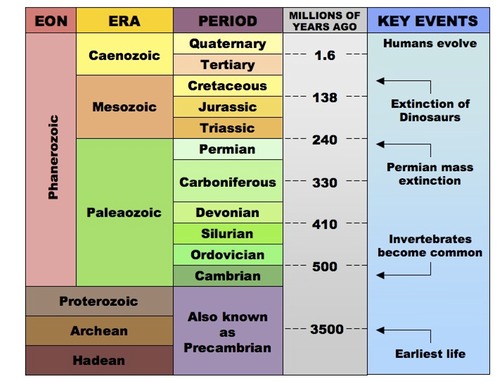
I should also mention here geologic eras. Earth's history is divided into sections (as you might well imagine -- 4.5 billion years can be pretty much unmanageable without some markers along the way). The largest are eons, which may be composed of several eras; subdivisions of eras are named periods, and further subdivisions, the smallest segments, are called epochs. The Hadean Era, which we've already encountered, is usually considered part of the Precambrian, which is where we are. (I'm probably not going to deal with anything larger than periods here.):


And that's enough for now. I'll get into the thorny question of how all those organic molecules got themselves organized into an actual organism next week.


Saturday, March 14, 2015

Saturday Science: Volcanoes

Well, one volcano, and this is more of a news item than a science item, but there's a new island in the South Pacific:

Thanks to volcanic activity, a new island has risen out of the waters of the South Pacific. Just don't start making Spring Break plans to go there yet. Scientists are warning that the new island is highly unstable and even boats should avoid passing too close.

Popping out of the water just 28 miles west of the tiny island nation of Tonga, the new land mass sprouted from the Hunga Tonga volcano, which became active back in December. It's the second time in five years that the volcano has erupted.

There's a lot of land that's formed this way -- think Hawai'i.


The surface is still very unstable, and the volcano could erupt again at any time, which hasn't stopped seabirds from nesting.

At any rate, for more photos, click through.


Saturday, February 28, 2015

Saturday Science: They Ate Clams

You don't think of Peru as a place to find crocodiles, and these days, you'd be right. Thirteen million years ago, however:
Thirteen million years ago, as many as seven different species of crocodiles hunted in the swampy waters of what is now northeastern Peru, new research shows. This hyperdiverse assemblage, revealed through more than a decade of work in Amazon bone beds, contains the largest number of crocodile species co-existing in one place at any time in Earth's history, likely due to an abundant food source that forms only a small part of modern crocodile diets: mollusks like clams and snails. The work, published today in the journal Proceedings of the Royal Society B, helps fill in gaps in understanding the history of the Amazon's remarkably rich biodiversity. . . .

Before the Amazon basin had its river, which formed about 10.5 million years ago, it contained a massive wetland system, filled with lakes, embayments, swamps, and rivers that drained northward toward the Caribbean, instead of today's pattern of eastward river flow to the Atlantic Ocean. Knowing the kind of life that existed at that time is crucial to understanding the history and origins of modern Amazonian biodiversity. But although invertebrates like mollusks and crustaceans are abundant in Amazonian fossil deposits, evidence of vertebrates other than fish have been very rare.

We should keep in mind that the eastern range of the Andes, the area in question, only began to form about 10 million years ago, much later than the western, coastal ranges. The Amazon River itself only started forming 11 million years ago, so the present configuration of the whole area is fairly new.

So, 13 million years ago, the Amazon basin was a swamp full of crocodiles digging for clams.

This model is a life reconstruction of the head of Gnatusuchus pebasensis, a 13-million-year-old, short-faced crocodile with globular teeth that was thought to use its snout to "shovel" mud bottoms, digging for clams and other mollusks. Model by Kevin Montalbán-Rivera.
Credit: Copyright Aldo Benites-Palomino

Something to think about.