"Joy and pleasure are as real as pain and sorrow and one must learn what they have to teach. . . ." -- Sean Russell, from Gatherer of Clouds

"If you're not having fun, you're not doing it right." -- Helyn D. Goldenberg

"I love you and I'm not afraid." -- Evanescence, "My Last Breath"

“If I hear ‘not allowed’ much oftener,” said Sam, “I’m going to get angry.” -- J.R.R. Tolkien, from Lord of the Rings
Showing posts with label history. Show all posts

Friday, February 07, 2020

Read It and Weep

While you still can -- this is almost beyond belief -- or it would be with any other administration. From an interview with historian Matthew Connelley:

So, you write, “The Department of the Interior and the National Archives have decided to delete files on endangered species, offshore drilling inspections and the safety of drinking water.” You also talk about, specifically, when we’re talking about ICE, that last month they announced that ICE could go ahead and start destroying records from Trump’s first year, including the detainees’ complaints about civil rights violations and shoddy medical care. Is this different from previous administrations?

It gets worse. It gets much worse.

This is straight out of something -- maybe a Monty Python sketch:

MATTHEW CONNELLY: It is. I would say that under this administration things have gone much further, much faster. I think perhaps the best example of that is how Donald Trump tears up his own papers in tiny little pieces. Now, in this case, the National Archives tried to do the right thing. They sent staff to the White House to Scotch tape those papers back together again. I’m not even kidding. So, what happened to them —

AMY GOODMAN: Say that again.

MATTHEW CONNELLY: They went to the White House to Scotch tape those pieces of paper back together again. These are our federal employees having to fish out of the trash pieces of paper that Donald Trump had left there rather than leaving a record for the rest of us. And so, they Scotch taped those records back together. So, what happened to those people? They were fired. They were terminated.

This is your government, ladies and gentlemen -- covering its tracks.

Thanks to commenter coram nobis at Joe.My.God.

Thursday, July 18, 2019

Giggle du Jour: A Look Back

Teenagers trying to figure out a rotary phone:

Monday, July 01, 2019

Stonewall: The Real Story

A very interesting video by a number of historians, some of whom were actually at Stonewall, that serves to debunk a lot of the myths and attempts at appropriation:

Friday, June 07, 2019

The Day After D-Day: Remembering the Forgotten

This is something I didn't know, part of this post from Adam L. Silverman at Balloon Juice:

There used to be a prevailing myth that no black men participated in D-Day — by far one of the most important days of World War II.

But a closer look reveals that some African-American soldiers played a key role on Omaha Beach, and their stories still remain largely untold.

"There were no (Congressional) Medals (of Honor) given to any black soldiers for what they did at D-Day," said 90-year-old Joann Snowden Woodson. "People really need to know the truth.”

Woodson has been on a consistent mission to share the truth of D-Day with the world, as well as the service of her late husband, Waverly Bernard Woodson — one of the few black soldiers known to have served on Omaha Beach that fateful day.

Originally from West Philadelphia, Waverly Woodson was a member of the 320th Barrage Balloon Battalion, an all-black Army unit that specialized in placing barrage balloons in battle areas during World War II. Their goal was to distract and destroy enemy aircraft and provide cover for Allied soldiers on the ground.

Waverly Woodson and his Battalion left England on June 5, 1944. They arrived on the beach in Normandy via transport boat the next day.

"He said he could see the soldiers being picked off just like flies," Joann Woodson reiterated. "Some of them were dead; some of them he had to administer the last rites. And some of them — I think he said he had to do amputations and everything."

Read the whole thing. And read Silverman's complete post as well. It's sobering when we think we've made progress in exercising our humanity.

(My dad served in the Pacific. He never talked about the war.)


Friday, February 01, 2019

Outrage du Jour

It occurs to me that with the Trump regime in place, I could make that an actual department on this blog. The problem would be deciding which one to highlight.

This one, however, deserves attention:

The U.S. Bureau of Land Management (BLM) is pushing ahead with the sale of oil and gas leases on land outside of Chaco Culture National Historical Park and other sites revered by Native American tribes, The Associated Press reported.

The latest listing — which quietly appeared on the BLM website not long after the government reopened after the shutdown — comes about a year after then-Interior Secretary Ryan Zinke postponed a lease sale in the Greater Chaco Region in response to intense public pressure over cultural and environmental concerns.

BLM will open a protest period for comments from Feb. 11 through Feb. 20 for a sale scheduled for March 28, according to the agency's notice. More than 50 parcels in New Mexico and Oklahoma will be on the auction block.

They will keep at it until they manage to do it. And it's not only the cultural and historical significance of the site: we're talking about an extremely fragile environment, in an area that is not so far away from the earthquake-prone West Coast -- and we know fracking contributes to earthquakes, or actually is a cause. I really have to wonder what kind of influence is at work here. Of course, since the GOP is working very hard to institute an oligarchy, this may just be the new normal.

In case you're not familiar with Chaco Canyon:


It happens to be a UNESCO World Heritage Site, as well.

With thanks to commenter JCF at Joe.My.God.

Sunday, March 18, 2018

Review: John Boswell: Same-Sex Unions in Premodern Europe

This is another one originally written for Epinions.com and no longer available there. In this case, context is important: it was originally written in 2003, when the push for marriage equality in the U.S. was just gathering steam: in 1993, the supreme court of Hawai'i, in Baehr v. Lewin, held that the state could not abridge marriage rights on the basis of sex; this, of course, led to the inevitable backlash, with states and the federal government passing laws and/or constitutional amendments to do just that. Then, in 2003, the Massachusetts Supreme Judicial Court decided in favor of the plaintiffs in Goodridge v. Dept. of Public Health; times had changed: the Massachusetts legislature couldn't muster the votes for a constitutional amendment or even a civil unions bill, and marriage equality became law in Massachusetts. (I might add that I caught a fair amount of flak on this one, mostly from people who objected to Boswell's conclusions.)

So, in that context, Boswell's book:


One considers seriously that the debate raging in the United States over same-sex marriage might have a more civil tone if all participants had read John Boswell’s Same-Sex Unions in Premodern Europe. It is a wide-ranging, carefully thought explication of the institution of marriage before the modern period of European history (generally considered to begin with the end of the Thirty Years’ War in the mid-fifteenth century), and does much to clarify the historical context of the debate.

Boswell devotes his “Introduction” to a discussion of the difficulties facing the historian in research, first in comprehending the context of the period, and then in making it clear to an audience. This is extraordinarily difficult in the area of social customs, because so much has changed, and so much is not recorded and must be reasoned from vague and often cryptic sources. Boswell stresses, quite rightly, that the historian must understand the vocabulary of the question, in this case marriage, in contemporaneous terms to bring any sort of understanding to the discussion. In Chapter 1, Boswell does a more than creditable job of clarifying the many forms that marriage took in the Mediterranean societies of the Classical, Hellenistic, and early Imperial ages, with particular appreciation for St. Augustine’s dictum that procreation was not a requirement for marriage (notwithstanding contemporary Church teaching to the contrary). What is interesting is the development of heterosexual marriage from an institution devoted entirely to economic, political, and dynastic concerns, in which the wife was essentially property bestowed on her husband by her father to cement an alliance between two families, to a contractual arrangement by independent adults (at least in theory – the arrangement was by no mean equal, except in social class). In light of this, it is no surprise that marriage in pre-Christian Europe was practiced by – and quite often permitted to – only the upper classes: those who had significant property. It is not until the later Empire that affection and attraction become acceptable considerations in arranging marriages. (It is also worth noting that, for the most part, priestly participation was an add-on – for the vast majority, once the financial agreements had been worked out, a simple declaration before witnesses constituted the ceremony: marriages were usually blessed by priests, but the crux was signing the agreements.)

Boswell goes on to discuss same-sex unions in pre-Christian Europe. Even for those familiar with some of the customs and expectations surrounding same-sex relationships in this period, he provides an enlightening commentary, pointing out that such relationships were expected to be long-term, ideally permanent, that the much touted age difference between erastes and eromenos in Greek custom (when it existed at all) paralleled exactly the ideal age difference in heterosexual marriage, and, no surprise to some, that same-sex relationships were expected to call forth the best characeristics of the lovers. (The U. S. military establishment comes in for a few pointed comments, as Boswell brings the history of the Sacred Band of Thebes – never defeated until they were wiped out to the last man at Chaeronaea – to bear on arguments about “unit cohesion” and “morale.”)

The chapter on marriage in the early Christian period is more than enlightening. Stunning is Boswell’s observation that “For the enthusiastic and devout, the most dramatic change in attitudes toward marriage was its profound devaluation.” The early Christian Church did not like the idea of sex under any circumstances, and far from promoting procreation as a divine mandate, held that the ideal marriage was never consummated. (Fortunately for the development of Christianity, the Church Fathers did finally, albeit grudgingly, admit that sex within marriage was acceptable – a somewhat lukewarm endorsement. One wonders if they were just bowing to the inevitable, since the vast majority of Christians paid as much attention to Church teaching in this area then as they do now.) Marriage did not become a sacrament within the Church for over a thousand years. Boswell also discusses several instances of “paired saints,” particularly SS Serge and Bacchus, who were without doubt a couple and were perceived as such at the time.

Perhaps the most revelatory chapters in the book are those treating the development of nuptial offices in the early Church, both heterosexual and homosexual, and their characteristics and history into the early Medieval period. Boswell cites an impressive wealth of sources that point to the almost exact parallels in treatment of the two (given that a same-sex union was less likely to involve the transfer of property or to reflect an unequal relationship in terms of relative authority). There is an extensive discussion of Roman law in this regard, since canon law was basically grafted onto that existing foundation, and Boswell goes into exhaustive detail on such ancillary issues as the adoption of brothers. What is remarkable is that the early Church’s de-emphasis of sex not only did not preclude same-sex unions, but actually made them more acceptable than they are today. Particularly instructive is the career of the Emperor Basil I, a nobody from Macedonia who “married” a wealthy Greek youth, John, at the behest of the youth’s mother and then, after assassinating the Emperor Michael (to whom he had been advisor and bedmate) summoned John to Constaninople to live with him. Boswell cites evidence from sources as diverse as the Eastern Empire, the Principality of Kiev, Spain, the Kingdom of the Franks, and Ireland as illustration of the widespread existence of same-sex unions entered under the auspices of the Church. He also notes anecdotal evidence of such unions entered into less formally.

The fourteenth century witnessed an abrupt shift in the Church’s position on same-sex unions, somewhat equivalent to the rise of the Church in the fourth century (at the beginning of which, Christianity was illegal, and by the end of which, it was the state religion). As Boswell points out, the reasons for this shift are obscure, save that the Church responded to growing public antipathy toward homosexuality (which had always been more marked in the West than in the East). This shift was hardly universal: Montaigne described witnessing a same-sex union performed by a priest in Rome in 1578, and there is documentation of a similar ceremony between two women which took place in a church in Dalmatia in the eighteenth century.

In his final chapter, Boswell examines some of the difficulties of the “history of history” in this area. It is no secret that Western society, particularly in England, Germany, and the United States, has a pathogical fear of homosexuality. It is therefore no surprise that this cultural context has colored the work of historians and anthropologists in describing the realities of other cultures, both contemporary and historical. Indeed, I remember my own dismay at the discovery that Jowett’s translations of Plato, long the standard, were heavily bowdlerized for just this reason. Boswell makes a good case for a clear-eyed view of history in this regard, one that I think can only be helpful in its honesty.

A highly respected historian, Boswell was careful in his research and very well aware of the dangers of transposing modern attitudes to historical events. As a writer, he is articulate, witty, sometimes acerbic, and very clear. He draws heavily on original documents as well as secondary sources (which makes the footnotes somewhat of a chore, unless you read French, German, Greek, Latin, Arabic, Hebrew, and Old Church Slavonic), and refers as well to hagiography, Christian iconography, Hellenistic romance novels, medieval folktales, and legal codes and decisions in clarifying his examination. There is no doubt that Boswell had an agenda; what is impressive is that the agenda does not infringe on the balance in his discussion. (In spite of the impression readers may have gained from my own summary discussion above, let me note that Boswell is very careful to point out ambiguities in usage and in the texts – this is not a work of polemic.) There are sections that are heavy sledding, particularly for those not familiar with the forms and methods of historiography. The footnotes, which are legion, are a distraction: although Boswell points out that one can read through without reference to the notes, someone conditioned by a lifetime of checking citations will find it almost impossible to ignore them. Boswell also includes as appendices translations of texts discussed, the texts in their original language, a discussion of the Jewish perspective, the text of a same-sex union, and the Passion of SS Serge and Bacchus.

I found “Same-Sex Unions” fascinating, but then, I have more than a passing fondness for history. For those who routinely tout the 3,000-year-old “tradition” of marriage, it would be instructive to find out just exactly what that tradition encompasses. For those who blithely point to antiquity as the touchstone of social approval for same-sex relationships, it would be equally instructive to learn just how tenuous that approval sometimes was. Boswell’s book brings a badly needed perspective to the furious debate raging on the subject of “gay marriage” in this country and others. I don’t think anyone can dispute that same-sex unions had their ups and downs in European history – but then, so did marriage.


Monday, March 05, 2018

Today's Must-Read: Whither America?

A thought-provoking and strangely reassuring piece from Tom Sullivan at Hullabaloo:

America is forever reinventing itself. Synthesizing today and yesterday and turning them into tomorrow. It was folly to believe a reality TV star could turn back time and recapture some halcyon yesterday. Yet many did.

They really believed they could turn back the clock to the halcyon days of Ozzie and Harriet. Key quote:

Instead of making America great again, Donald Trump is instead hastening "the very decline his supporters so feared," Reid concurs. There will be no return to a world where white men rule and all others know their places and remain in them[.]

That's the thing about history: it's a function of time, and no matter how hard you try to stop it, time keeps marching on.

Needless to say, read the whole thing: it's a good analysis of demographics and where they are taking us.

Friday, December 08, 2017

Can You Say "Clueless"?

Trump takes ignorance to a new level:

Democratic U.S. Congressman John Lewis of Georgia is one of this nation's top and most-recognized civil rights leaders. He was the chairman of one of the primary civil rights organizations that organized Dr. Martin Luther King Jr.'s 1963 March on Washington for Jobs and Freedom, during which King delivered his famous "I Have a Dream" speech. Lewis also delivered a speech at that historic event and was the youngest man to do so. He has been beaten, arrested, and jailed in his fight for civil rights.

Rep. Lewis has decided he cannot stand on the same stage as President Donald Trump this Saturday, when Trump will visit the Mississippi Civil Rights Museum. . . .

The White House saw fit to denounce them for it.

"We think it’s unfortunate that these members of Congress wouldn’t join the President in honoring the incredible sacrifice civil rights leaders made to right the injustices in our history," Sarah Huckabee Sanders said in a statement to reporters. "The President hopes others will join him in recognizing that the movement was about removing barriers and unifying Americans of all backgrounds."

If if were anyone but Trump -- and parrot-in-chief Sanders -- I wouldn't believe it.

Footnote: Digby caps it nicely:

That's Sarah Huckabee Sanders explaining that the civil rights movement wasn't really about black people.

Thursday, November 23, 2017

Wrong Question

Digby seems to be making a connection -- or trying to -- between Eastern European origins and sympathy for Nazis:

A Minnesota man accused of committing war crimes when he commanded a Nazi-led unit during World War II contributed thousands of dollars to the Republican National Committee, a Daily Beast review of federal campaign records found.

OK -- this guy was, for all intents and purposes, a Nazi. But she goes on:

I had a landlord who was a Polish immigrant of that generation and he worshiped Ronald Reagan too. I don't think he was a an actual Nazi. But he could have been. He certainly didn't like Jews.

Anti-Semitism was pretty much a given in Eastern Europe during the 1930s and 40s, and long before. But the idea that Eastern Europeans of that generation -- or the next -- were Nazis or sympatherizers I think misses one very important factor.

When I was the at the University of Illinois in Chicago, I met a lot of Lithuanians whose parents had fled the country after World War II. Most of them had been born in Germany in 1945-46 or thereabouts. And they were all very right wing. They weren't Nazis -- they were hard-core anti-Russian, simply because of the Soviet occupation of Eastern Europe after the war. And I can't begin to describe just how much they hated Russians.* (Just to give an idea of the depth of nationalism in this group of displaced people, there was a Lithuanian government in exile in the U.S. as late as the 1960s. Noted science fiction writer Algis Budrys was president. To a certain extent, it's a very deep-seated case of denial.)

All of which is to say that it's a little simplistic to try to connect emigration from Eastern Europe in the 1940s with Nazi sympathies -- it's much more a matter of being anti-communist, or more specifically, anti-Soviet.

* This is in large part just the twentieth-century manifestation of attitudes that go back several hundred years. In the fourteenth and fifteenth centuries, Lithuania was the dominant power in Eastern Europe, stretching from the Baltic in the north to the Black Sea in the south and including Ukraine and a large chunk of Byelorussia. (It was also the only country in Europe with religious freedom, including Jews.) The Union of Lublin (1569), which joined the Kingdom of Poland with the Grand Duchy of Lithuania in a unified political state (as opposed to the personal monarchy that had existed since the late fourteenth century) shored up the Lithuanian state in its wars with the emerging Muscovite kingdom, which had been going on since the Muscovites had thrown off the Mongols. So this antipathy goes back quite a way. This resentment of Russia was only exacerbated by the Partitions of Poland in the eighteenth century -- Lithuania and a large chunk of Poland proper wounder up as part of the Russian Empire. They gained independence after World War I, only to be re-occupied during World War II.

Yes, on top of everything else, I'm a history buff. I think it's genetic.

Thursday, August 17, 2017

Image du Jour

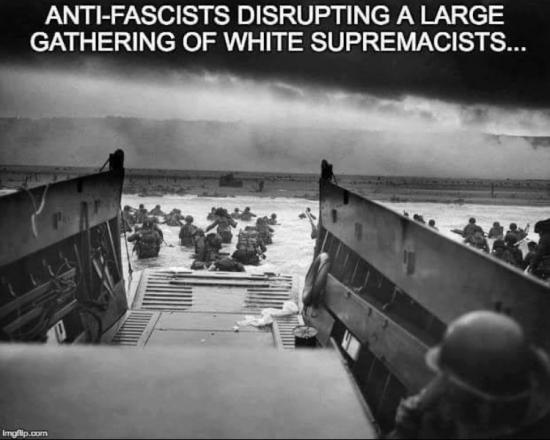
In light of Trump's "both sides" rhetoric and the continuing efforts of the Charlottesville Nazis to proclaim themselves the victims of hostile leftists, I present this, courtesy of commenter Gigi at Joe.My.God.

Thumbnail

And another from The Guardian, via Bark Bark Woof Woof:

Monday, July 17, 2017

Quote du Jour

The summation of this post at Mahablog:

But it’s also the case that for the more fanatical Christians in the U.S., the Bible ceased to be a scripture a long time ago. It’s become more of a totem, a sacred symbol assumed to have spiritual power that represents the tribe of self-proclaimed conservative Christians. What it actually says about anything is irrelevant.
(Emphasis added.)

I'm sure you can all come up with examples of "Christians" who give no evidence of ever having read the Scriptures.

The article itself is about the Green family, of Hobby Lobby fame, and their looted biblical antiquities. It's a good example of what happens to your sense of morality when your sacred text becomes a mere totem, losing all real meaning.

Sunday, May 07, 2017

Yep -- Another Must Read: Pirvatizing Our Heritage

Trump's assault on America is certainly multi-valent. I've touched on this before
, but it bears repeating, since Trump seems hell-bent on doing away with our pubic lands.

In the few days since President Trump issued his Executive Order on National Monuments, many legal scholars have questioned the legality of his actions under the Antiquities Act. Indeed, if the president attempts to revoke or downsize a monument designation, such actions would be on shaky, if any, legal ground. The Conversation

But beyond President Trump’s dubious reading of the Antiquities Act, his threats also implicate a suite of other cultural and ecological laws implemented within our national monuments.

By opening a Department of Interior review of all large-scale monuments designated since 1996, Trump places at risk two decades’ worth of financial and human investment in areas such as endangered species protection, ecosystem health, recognition of tribal interests and historical protection.

It's worth reading the whole article, just to get a good idea of what we stand to lose.

Hopefully, a few court challenges will stop this cold.


Friday, March 17, 2017

Art? Culture? History? Who Needs 'Em?

Interesting article from TPM on the threat to eliminate the National Endowment for the Arts and the National Endowment for the Humanities. It's another budget cut that will impact smaller towns and rural communities the most, of course -- another kick in the teeth to The Hairpiece's base.

I found this telling:

Advocates feel they have a good chance of lobbying Congress to save funding for the endowments, which they say fund programs that offer crucial support to the public education system, help veterans readjust to civilian life and bring arts and culture to small communities.

“What we have here is an attack upon global citizenship and national civic culture," Jim Grossman, the executive director of the American Historical Association, told TPM of the potential elimination of the NEH.
(Emphasis added.)

That's the point. Digby pointed out that Trump's proposed budget is authoritarian. I'll go a step further: it's a dictator's budget. The devil's in the details, as they say, and that comment about global citizenship and civic culture underscores it: that's the point.

Dictators start off by controlling the media, or trying to, and Trump's got the media chasing its tail 24/7.

And next they rewrite history. And the best way to accomplish that is to be sure that there are no other sources available, no other viewpoints to be had.

I wonder how successful he's going to be. He makes a big deal about how social media enables him to go directly to his supporters, but, as we've seen, that cuts both ways. And the cuts can be really sharp.

Monday, January 16, 2017

Today's Must-Read: NATO, the EU, and the Rise of the Right

Excellent analysis by Adam L. Silverman at Balloon Juice on what NATO and the EU are really about and why they are now even more necessary than ever before. Key insight:

This is the real, tangible benefit of the EU and NATO. Its not a common market or a mutual defense pact. The real benefit is that the EU and NATO have broken the reality of over a thousand years of conflicts, capped off by World Wars I and II, in Europe and among the people of the nation-states that make up Europe.

One of my many minors in college was history, with an emphasis on modern European diplomatic history. And one of the ongoing themes there was the "balance of power." And one aspect of that was integrating Russia into the European community. Silverman points out the one big failure in the West's post-Cold War policy, which was excluding Russia from that community. And Russia is currently feeling the effects of that marginalization: faced with a newly robust and vital China on the one hand and a unified Europe and America on the other, Russia really has no choice to but try to break things up. China's out of the question. Europe, on the other hand, especially with the UK leaving the EU, is ripe for dismemberment, and Putin has a willing puppet in Trump's America.

Fasten your seat belts, etc., etc.

Thursday, November 10, 2016

Reflections: Dada Writ Large

I may do this as an occasional department, titled "Reflections." Mostly just expansions on thoughts that occur to me relevant-- or tangential -- to something else.

So, "Dada Write Large"? I think there's a strong element of Dada in where we are right now, not only as country, but as a world.

Dada was designed to be ghost-like and short-lived. An intransigent and inconsequential mockery of the vain conceit that cultural monuments stood for something immortal, something ever-lasting. Self-immolation was written into Dada's very DNA, its main aesthetic tenant its brevity and self-destructiveness. There are no world-renowned Dadaists on the scale of a Hemingway, or a Shostakovich, or a Picasso, and no Dadaist produced a particularly large body of work-- not least because so many of the good ones killed themselves as the ultimate expression in Dadaist performance art. If you've never even heard of the movement, you're hardly to be blamed-- the Dadaists were simply there one day-- like a wisp of smoke swirling briefly, illuminated by a moonbeam-- and the next were gone. Rarely do artistic movements fulfill their stated intentions so completely-- Dada was a fully-realized, soulless expression of Dionysian excess. A howl of existential despair. And a casualty of war.

Expand that beyond the bounds of "art" (a boundary that I think is artificial and ultimately destructive -- art is about life; when it stops being about life, it loses its value). We've just elected the American id as president, and the world is reeling. (No, it's not just us in a state of shock, although most world leaders are offering at least pro forma congratulations -- albeit with some gentle -- or not so gentle reminders of what our shared values actually are. But if you look at where the most effusive congratulations are coming from -- Golden Dawn, the right-wing exremists in Greece; Marine le Pen, the leader of the neo-Nazi rightists in France; the right-wing extremist premier of Hungary -- you get a very different take on the world's reaction.)

But, back to the Dada aspects of this: The foundation, the part that was stressed by my art history teachers, was a sort of over-riding nihilism. Ironically enough, the last thing on the minds of those who elected Trump was destroying the social order -- just the opposite: they feel that the social order is under attack and they're trying to get back to the "real America" -- the one they grew up with. They're not wired to accept change very easily, but, sadly for them, life is change. That applies to cultures no less than organisms. So there's a new social order that doesn't match their expectations. In trying to get back to the safe, comfortable place they remember, they've taken a step toward destroying what is without any hope of replacing it with what was.

This is instructive:

One thing was certain though -- the Dadaists weren't in the game as mere dilettantes, or hobbyists. Their outrage was real, a genuine reaction to the horrors of the war. And shock and awe (to borrow a modern-day locution) seem to have been their modus operandi. None of the Dada art that survives can be called aesthetically pleasing in any usual sense-- to be displeasing was, after all, the whole idea.

There you have the Trump campaign. Wonder how that's going to translate into the Trump presidency.

Fasten your seatbelts -- it's going to be a bumpy ride.


Thursday, September 01, 2016

Here We Go Again

You may have heard that Matt Bomer was cast as a transgender woman in the film Anything.

As you can imagine, the trans community -- or at least, a vocal segment of it -- is up in arms. On social media, of course, because that way you don't actually have to think about what you're saying. This is one of the least hostile tweets:


Jamie Clayton Retweeted Trans Hollywood

I really hope you both choose to do some actual good for the trans community one day.


Bomer blocked her on Twitter, temporarily (apparently, he has now unblocked her). I would too -- this is the kind of condescending crap he doesn't need to put up with. Bomer, as a matter of fact, has been a strong supporter of trans rights, which makes Clayton's tweet even more offensive.

The idea that trans characters must be played by trans actors is, on its face, ludicrous. These are actors. They make their living pretending to be someone else and if they make us believe they are that other person, we consider them good actors. As for what considerations go into casting a role, I've been there: you're looking for the actor who is a fit for the character. You're not thinking of the actor's real-life sexual orientation or gender identity -- those are irrelevant; you're looking for the actor who is capable of moving into this character and making the character real. When I was in college I was routinely cast as old men; I was skinny, had an angular face that would take age makeup well, and I could move the way an old man moves. I was nineteen or twenty. Hollywood has the added burden of name recognition: they have to have something to draw the audience, and casting a high-profile actor is one of those somethings.

But back to the core complaint: visibility of trans people. The fact that the film is being made at all, or that other films with trans characters have been made and been successful, seems to elude this group. They're not registering on what this actually means. I realize that at this stage of the game, when the trans community is coming under attack from the "Christian" right (now that gays and lesbians are pretty much mainstream), they want real trans people to be more visible. But this set of circumstances shows us that we're dealing with a two-pronged issue: resistance and inertia.

When I was a kid -- and I knew from a very early age that I liked boys -- there's wasn't even such a thing as a "gay man." There were only "queers," who were shady, diseased, and dangerous, and universally despised. You never saw gay characters on TV and seldom in films, and when you did, they fit the stereotype: sick, pathetic, and just barely people. I was hungry enough for any representation of people like me that even that was a plus: at least we existed. It took fifty years, but that's changed a lot. And it was the same process: overcoming first inertia, and then overcoming resistance.

And I have to say, these representations of trans characters are a lot more sympathetic than the early representations of gay characters in film. I can't stress how important that is: it means that the inertia of the status quo -- the stereotypes -- is already a thing of the past. So in that regard, Trans Hollywood's tweet is flat out wrong.

So, however much you may hate it, changing people's perceptions of marginalized groups takes time. It means you have to overcome the inertia of the status quo and the resistance of those who need someone to hate to justify their own existence. Having a very public snit because it's not happening the way you think it should doesn't help -- in fact, it's as likely to damage your cause as anything else, because you've shown yourself to be immature and not ready for prime time.

When we have trans actors and actresses playing cis characters in major motion pictures, then we're there.


Monday, July 04, 2016

Today's Must-Read, 4th of July Edition

Interesting and very thorough article on the significance of Prop 8:

Although the Supreme Court dismissed the challenge to Proposition 8 on a technicality, the long and winding struggle against it nevertheless was pivotal in the quest for equal rights under the law, as well as in the sweeping marriage equality victory that was to come two years later when the Supreme Court ruled in Obergefell v. Hodges that gay men and lesbians had a fundamental right to marry.

A quick video summary:


Read the article -- it's lengthy, but you won't regret it. Trust me.

Happy Independence Day.


Tuesday, June 28, 2016

Two Must-Reads

The first, from Jim Burroway at Box Turtle Bulletin, on Stonewall and what it means.

It’s kind of like the story about Paul Revere’s ride and the Battle of Lexington. Or the story of the Mayflower and the Pilgrims’ first Thanksgiving. Or the story about Christ in the manger or Adam and Even in the Garden. What actually happened that day matters relatively little because Stonewall has gone way beyond all those mundane details. It has become our origin myth. And like all origin myths, it’s all about the idea of what happened when that world began: a police raid on a dingy and not particularly popular mafia-owned gay bar, people who had nothing to lose and who fought back, a community that organized against all odds and marched, and kept marching for more than four decades to bring us where we are today. It all traces back, like a straight line — at least in our imagination — to that hot Friday night on Christopher Street.

As you might imagine, the origin myth idea resonates with me in a big way. (And I'm chagrined that I didn't spot that right away. Me, of all people.) He's right: human beings are myth-makers; it's how we find our place in a universe that is much bigger than we are.

This, in particular, relates to my post of yesterday, at least the part about the so-called "whitewashing" of Stonewall:

As is true with all origin myths, this one gets recast with each generation’s telling, complete with new heroes. Last summer, the semi-fictionalized Stonewall movie, which bombed at the box office, was criticized for “whitewashing” the rioters and “erasing” other minority communities who were out that night. That criticism was part of a newer re-telling of Stonewall, where some argue that it was a specifically transgender uprising and a specifically people-of-color movement. Gay white men, that argument goes, have stolen the real history of Stonewall.

People who were actually there in 1969, including two leading transgender activists, dispute that. Dana Bryer wrote, “I was there [at the Stonewall Uprising] the second night, too, and the streets were overwhelmingly filled with white men (which included the way I was perceived back then, too).” Lesbian activist Robin Tyler added, “I was there [at the Stonewall Uprising] the second night. The majority of protesters were white gay men.”
But of course, transgender people were there. So were people of color. And women. Some were all three, and more. All of that is true. And it’s also true that history is typically recorded from a white male viewpoint. And so ensuring that history is accurately recorded matters a lot, as does making sure it is comprehensively recorded.

Yet the arguments over “whitewashing” (or historical revisionisms to accommodate political imperatives, depending on your perspective) miss the far bigger picture. Because Stonewall has become our creation myth, we all have a natural human need to see ourselves, directly, in that story. Just as Ethiopian Orthodox Christians have for millennia painted their icons depicting Jesus, Mary and Joseph as Africans, just as Asian missionaries gave the saints Asian facial features, just as Egyptian Coptics drew the martyrs and prophets (perhaps most accurately) as inhabitants of a harsh Mideast desert, and just as Caucasians around the world turned their prayerful gaze upon a Nordic blue-eyed Jesus, we too, in our rich diversity, also need to see ourselves in our foundational story. Those very parochial responses are powerful illustrations of the truly universal ways those stories speak to us. As I said, no impulse could ever be more human.

What we seem to have here, at least in terms of myth and metaphor (and the two are intimately related) is a collision between versions of the creation story. One hopes that eventually they will settle out into a version that includes all of us. (To go back to my original contention about the film Stonewall: It's fiction, and by that measure contributes to the myth-making. It's not "history" and never claimed to be, so as far as I'm concerned, the cries of "whitewashing" are out of place.)

The second is not about myth-making, but establishing a benchmark. The Supreme Court yesterday handed down its decision in Whole Women’s Health v. Hellerstedt Et Al striking down Texas' law restricting access to abortions.

As Tara Culp-Ressler notes, this decision is likely to have a significant impact across the country, and it’s easy to see why. Laws such as the one that was before the Court in this case are on the books in twenty-five other states. While many of them are in one stage or another of Federal Court review, they have yet to proceed as far as the Texas law has. This ruling means that their legal journey is effectively at an an end, and that those laws that have not been challenged as of yet are likely to find themselves being challenged as unconstitutional as well. The outcome of those cases would seem to be rather obvious. This means that a significant legislative strategy of the anti-abortion/pro-life movement is now cut off, leaving them searching for a new strategy to try to restrict access to abortion while not running afoul of the law. Today, the Supreme Court made clear just how difficult that is going to be.

What the court did in Whole Women's Health was to clarify the "undue burden" requirement established in Planned Parenthood v. Casey, mandating a much tighter reading of the concept with much less deference to legislatures' stated (as opposed to real) motivations. Oh, yes, this is going to have repercussions.

Monday, June 27, 2016

And History Repeats Itself

Two stories that caught my attention this morning (well, over the past couple of days, but I was focused on other things).

First, this, from Towleroad:

San Francisco Mayor Ed Lee, gay state Senator Mark Leno, and gay SF Supervisor Scott Weiner were booed off stage at a kickoff event for the annual Trans March in San Francisco, KRON reports:

“My first year in Sacramento, we added gender identity to the Fair Employment Housing Act,” state Sen. Mark Leno said.

But he was mooned by a heckler and booed by several others. Openly gay state Sen. Leno was yelled off the stage, as was Scott Weiner, a member of the San Francisco Board of Supervisors and also openly gay, and Lee.

Lee and Weiner didn’t even have a chance to speak.

“Though this has not been a warm welcome or one of respect, I will continue to fight for transgender rights, equality, and the respect that you’re not giving us today,” Leno said.

This is what caught my eye:

“I’m upset because I’m a Trans woman who has a lot of Trans friends who are homeless, and I’m tired of people using our community as a prop, a political prop,” Ashley Love said. “I’m tired of white, gay men riding the Stonewall movie and reducing Trans women of color to secondary props, to historical props, to social props, political props. I’m tired of politicians coming here for 5 minutes, do a little sound bite, and run off, but do they really care about us?”

I've seen this before: in the 1970s-80s, I watched the New Left take over the gay rights movement, which up until then had been pretty well focused and pretty effective. All of a sudden, it was "Yes, we'll work on equal rights for gays and lesbians, but first we have to end war and world hunger." It took a decade and the AIDS epidemic to regain momentum. Now, suddenly, the trans rights movement has to take on homelessness.

And as for white gay men "whitewashing" Stonewall, read this:

Two longtime LGBT leaders/activists, who were at the Stonewall uprisings, one transgender and one lesbian, have just weighed in publicly. Here’s what they witnessed that night.

Trans leader Dana Beyer writes:

“I was there [at the Stonewall Uprising] the second night, too, and the streets were overwhelmingly filled with white men (which included the way I was perceived back then, too).”

Lesbian activist Robin Tyler:

“I was there [at the Stonewall Uprising] the second night. The majority of protesters were white gay men. And a lot of people were very upset about the death of Judy Garland and their grief turned into anger. We talked about it.”

All the documentary evidence, eyewitness accounts, what have you, point to the fact that the majority of the demonstrators/rioters were white gay men. As Aravosis points out, yes, there were trans people of color, mostly trans women, heavily involved, front and center, but let's not have a lot of bullshit about "whitewashing."

It's worth noting that the controversy was sparked by a two-minute trailer.

Pat Cordova-Goff, an 18-year-old who describes herself as a “trans woman of color” and a student at Citrus College in Glendora, Calif., created the Gay-Straight Alliance Network petition calling for a boycott of “Stonewall” after watching the trailer. The petition has now racked up more than 24,100 signatures.


And, strangely enough, we hear from Ashley Love again:

“Seeing the film in its entirety was disappointing in how once again white gay men reduce trans women of color down to historical, social and political props,” said Ashley Love, 35, a journalist and coordinator with the education group Stonewalling Accurate & Inclusive Depictions. Describing herself as a black and Latina woman of transsexual history, she said that the film further highlighted “issues of classism, trans-misogyny, anti-blackness, Hollywood trans-face casting, misgendering, identity appropriation and transparent propaganda.”

What I'm hearing is a lot of ideologically generated bullshit, backed by a desire to be in the spotlight.

And, for the love of all that's holy, the film is not a documentary, it's fiction.

What I'm seeing in both these stories is ideological (read "moral") purity overtake all other considerations. (Fiction is supposed to reflect your agenda? Since when?) I saw it in the '80s, with the rise of the New Left and its "politically correct" approach to everything, and if you look real hard (actually, not all that hard), you'll find it on the anti-gay right, and in fact, the contemporary conservative movement (which shares with the fringe left the inability to differentiate fiction from reality).

And that approach is self-defeating. By all means, boo the people who are in the best position to help advance your cause, and boycott a movie that's going to do more to raise awareness than you're ever going to do. That will be real effective, won't it?