"Joy and pleasure are as real as pain and sorrow and one must learn what they have to teach. . . ." -- Sean Russell, from Gatherer of Clouds

"If you're not having fun, you're not doing it right." -- Helyn D. Goldenberg

"I love you and I'm not afraid." -- Evanescence, "My Last Breath"

“If I hear ‘not allowed’ much oftener,” said Sam, “I’m going to get angry.” -- J.R.R. Tolkien, from Lord of the Rings
Showing posts with label society. Show all posts

Monday, September 02, 2019

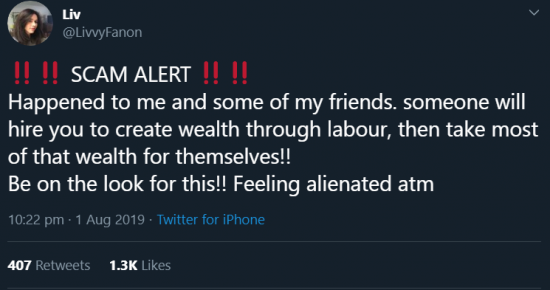
Tweet du Jour

Thumbnail


It's called "capitalism".

Happy Labor Day.

With thanks to commenter Reality.Bites at Joe.My.God.

Tuesday, January 15, 2019

Commercial du Jour

Maybe of the year. I don't watch regular TV, so I seldom have any take on ads unless they start generating news on their own. This one is:


In the context of the accusations of harassment and sexual abuse over the past few years, I guess better late than never. I will point out, though, that it took a national movement to penetrate the boardroom, which, in the case of abuse of women I find instructive: corporations have been very quick to respond to the gay community. Maybe this is why we can't have a woman president.*

The incels and right-wing nutjobs at YouTube are losing it over this one. I wonder why.

Via Joe.My.God.

* Stray thought: So many other countries have had female heads of state or heads of government -- the UK, Germany, Iceland, India, Sri Lanka, Israel, Brazil, Argentina, Chile, Liberia, just off the top of my head (and I'm sure I'm missing some) -- and yet America elected a black man as president and still hasn't elected a woman. We haven't even elected a ticket that included a woman as VP. That says something.

Thursday, July 06, 2017

Stray Thought For the Day

America has become socially backward in a couple of respects. That popped into my head while reading this article, specifically this:

Getty Images, Via PinkNews
Leo Varadkar, the first gay leader of Ireland, has met with LGBT-friendly Canadian Prime Minister Justin Trudeau – and they were so happy together.

Varadkar took office as Ireland’s Taoiseach last month, becoming one of just five openly gay heads of government in recent global history.

There are only two other openly gay leaders currently in office: Luxembourg’s Prime Minister Xavier Bettel and Serbia’s Prime Minister Ana Brnabić.

(For an explanation of the socks thing, see the article.)

There have actually been, according to Wikipedia, fourteen gay, lesbian, bisexual, transgender or otherwise not straight heads of government.

And according to Time, there have been 70 women elected or appointed as heads of government or heads of state*, which puts the U.S. behind such bastions of male privilege as Pakistan, India, Sri Lanka, Brazil, Chile, Liberia. . . .

Get my drift?

We elected an idiot with no experience in politics, a shady history in his business dealings, and no impulse control over a woman who was eminently qualified to be president.

Think about that.

* To clarify, in a parliamentary system, the prime minister is the head of government, i.e. Theresa May of the UK; in that case, Queen Elizabeth II is the head of state. In a parliamentary system with no monarch, the president is the head of state, which differs from a system such as ours, in which the president is both head of state and head of government.


Friday, March 17, 2017

Art? Culture? History? Who Needs 'Em?

Interesting article from TPM on the threat to eliminate the National Endowment for the Arts and the National Endowment for the Humanities. It's another budget cut that will impact smaller towns and rural communities the most, of course -- another kick in the teeth to The Hairpiece's base.

I found this telling:

Advocates feel they have a good chance of lobbying Congress to save funding for the endowments, which they say fund programs that offer crucial support to the public education system, help veterans readjust to civilian life and bring arts and culture to small communities.

“What we have here is an attack upon global citizenship and national civic culture," Jim Grossman, the executive director of the American Historical Association, told TPM of the potential elimination of the NEH.
(Emphasis added.)

That's the point. Digby pointed out that Trump's proposed budget is authoritarian. I'll go a step further: it's a dictator's budget. The devil's in the details, as they say, and that comment about global citizenship and civic culture underscores it: that's the point.

Dictators start off by controlling the media, or trying to, and Trump's got the media chasing its tail 24/7.

And next they rewrite history. And the best way to accomplish that is to be sure that there are no other sources available, no other viewpoints to be had.

I wonder how successful he's going to be. He makes a big deal about how social media enables him to go directly to his supporters, but, as we've seen, that cuts both ways. And the cuts can be really sharp.

Sunday, February 26, 2017

Today's Must-Read: Define "Great"

This article by David Rothkopf in Foreign Policy, which tom Sullivan quotes extensively in this post at Hullabaloo. Rothkopf's thesis:

The shallow state is in many respects the antithesis of the deep state. The power of the deep state comes from experience, knowledge, relationships, insight, craft, special skills, traditions, and shared values. Together, these purported attributes make nameless bureaucrats into a supergovernment that is accountable to no one. That is a scary prospect. But the nature of bureaucracies, human nature, inertia, checks and balances, and respect for the chain of command makes it seem a bit far-fetched to me. (The bureaucracy will drive Trump, like many presidents, mad, and some within it will challenge him, but that’s not the same thing.)

The shallow state, on the other hand, is unsettling because not only are the signs of it ever more visible but because its influence is clearly growing. It is made scarier still because it not only actively eschews experience, knowledge, relationships, insight, craft, special skills, tradition, and shared values but because it celebrates its ignorance of and disdain for those things. Donald Trump, champion and avatar of the shallow state, has won power because his supporters are threatened by what they don’t understand, and what they don’t understand is almost everything. Indeed, from evolution to data about our economy to the science of vaccines to the threats we face in the world, they reject vast subjects rooted in fact in order to have reality conform to their worldviews. They don’t dig for truth; they skim the media for anything that makes them feel better about themselves. To many of them, knowledge is not a useful tool but a cunning barrier elites have created to keep power from the average man and woman. The same is true for experience, skills, and know-how. These things require time and work and study and often challenge our systems of belief. Truth is hard; shallowness is easy.
(Emphasis added.)

Read them both. (Yes, I know, another twofer. You can handle it.)

Monday, September 28, 2015

Yeah, I'm Still Here

Somewhere. I've been apprised that my absence has been noticed. It's nothing serious -- just that the news is more of the same, only kicked up an order of magnitude, and the combination of Kim Davis (who got an award for breaking the law) and the Republican presidential wannabes is sort of paralyzing.

This, however, interested me. Via Digby:

One 15-year-old I interviewed at a summer camp talked about her reaction when she went out to dinner with her father and he took out his phone to add “facts” to their conversation. “Daddy,” she said, “stop Googling. I want to talk to you.” A 15-year-old boy told me that someday he wanted to raise a family, not the way his parents are raising him (with phones out during meals and in the park and during his school sports events) but the way his parents think they are raising him — with no phones at meals and plentiful family conversation. One college junior tried to capture what is wrong about life in his generation. “Our texts are fine,” he said. “It’s what texting does to our conversations when we are together that’s the problem.”

The fallout from this is pretty substantial:

In 2010, a team at the University of Michigan led by the psychologist Sara Konrath put together the findings of 72 studies that were conducted over a 30-year period. They found a 40 percent decline in empathy among college students, with most of the decline taking place after 2000.

Across generations, technology is implicated in this assault on empathy. We’ve gotten used to being connected all the time, but we have found ways around conversation — at least from conversation that is open-ended and spontaneous, in which we play with ideas and allow ourselves to be fully present and vulnerable. But it is in this type of conversation — where we learn to make eye contact, to become aware of another person’s posture and tone, to comfort one another and respectfully challenge one another — that empathy and intimacy flourish. In these conversations, we learn who we are.

I have so far resisted that sort of connectivity -- I don't have a cell phone, and I've avoided getting involved in most social media -- no Facebook, no Twitter, none of that. I do notice, however, the number of people I see -- mostly younger people, but by no means exclusively -- who are on the bus, or walking down the street, or in coffee shops or restaurants -- who aren't really there. They're on their phones. I remember seeing people on rollerblades with their ears stopped up with earphones while they were 'blading down the sidewalks or streets, and thinking "These people must be nuts -- that's a great way to get killed." Phones aren't quite that extreme (although a lot of these people are listening to music), but still. . . . They're not only shutting themselves off from human contact, but from the world around them.

I have seen this resilience during my own research at a device-free summer camp. At a nightly cabin chat, a group of 14-year-old boys spoke about a recent three-day wilderness hike. Not that many years ago, the most exciting aspect of that hike might have been the idea of roughing it or the beauty of unspoiled nature. These days, what made the biggest impression was being phoneless. One boy called it “time where you have nothing to do but think quietly and talk to your friends.” The campers also spoke about their new taste for life away from the online feed. Their embrace of the virtue of disconnection suggests a crucial connection: The capacity for empathic conversation goes hand in hand with the capacity for solitude.

In solitude we find ourselves; we prepare ourselves to come to conversation with something to say that is authentic, ours. If we can’t gather ourselves, we can’t recognize other people for who they are. If we can’t gather ourselves, we can’t recognize other people for who they are. If we are not content to be alone, we turn others into the people we need them to be. If we don’t know how to be alone, we’ll only know how to be lonely.

Bus rides are part of my "alone time" -- I seldom even read on the bus: I watch the world outside, and the people riding with me. But then, I've always been an observer. And I have a high tolerance for being alone.

I wonder if it's a fear of being alone that drives part of this technological connectedness. After all, we're social animals, hard-wired to travel in groups. Being alone is something that a lot of people avoid, I think, even in situations like running errands or riding the bus -- so, grab your phone and stay connected. Except you're not, really.

It's sobering to realize how much of our communication relies on the nonverbal -- facial expression, body language, tone of voice -- that you don't get on a phone or on the Internet. That's what really does the damage. (Why do you think emoticons were invented? An attempt to replace some part of what we're missing by face-to-face contact.)

There's a lot more to be said on this topic -- I find myself tempted to wander off on all sorts of tangents, but I'm not going to. Read both the Times article and Digby's post, and you can wander off on your own tangents.


Sunday, January 11, 2015

They Might As Well Give Up

I spend way too much time surfing the Internet these days, when I should be doing things like cleaning house, but I do see some interesting trends.

If you follow this blog, you know I've spent a fair amount of time covering the marriage fight, but that's only part of the picture -- a high-profile part, to be sure, but only part. That's where the major campaign has been waged in the past few years, that's the one getting all the press, and that's the one leading to much wailing and rending of garments on the part of the guardians of "traditional values." (Who, as far as I'm concerned, have as much understanding of values as they do of morality, which is to say, rudimentary, at best.)

Yes, marriage is a fundamental and very important institution, but there's another one that's equally important and, if I may hazard an opinion, equally foundational: marketing.

OK, he's lost it, you're thinking. But consider: we are basically a capitalist society. Not purely capitalist, because that inevitably leads to disaster, but in all essentials, we have private producers and purveyors who offer goods and services to the public. It's a consumer driven economy, and a society that is ultimately very materialistic. And of course, marketing is the means by which the producers and purveyors try to convince the consumers to buy their particular brand.

And look what's been happening lately:

From Banana Republic:


That's Nate Berkus and his fiance, Jeremiah Brent, in a campaign highlighting "real relationships."

And from Tiffany:


The couple, who are a real gay couple, remain anonymous at this point, but the caption is a winner:

"Will you promise to never stop completing my sentences or singing off-key, which I'm afraid you do often? And will you let today be the first sentence of one long story that never, ever ends? Will you?"

And to cap it off, this spot for the ACA:

(Via Joe.My.God.)

This is also a real-life couple.

The intent in these ads is plain: they want to appeal to younger people, those who are growing up with the ideas of diversity and inclusiveness (which, after all, are real American values: without those in the mix, this country would not have survived) as a firm part of their world view, and they want to appeal to the great middle, that majority of Americans who are not bothered by the idea of equal rights, including marriage, for gay people. They're aiming for the mainstream, which the Tony Perkinses and Bryan Fischers and Brian Browns are not. Americans are, on the whole, a tolerant people, no matter what you hear from the fringes. (And it's only the fringes that seem to get any coverage these days, I guess because they're loud and obnoxious and that somehow translates into ratings.) We as a people are pretty much live and let live, and we're rapidly approaching the point, if we're not already there, that for most people, something like that ad caption above generates an "Aww" and not a heart attack.

These are only the latest in a series of similar ads and TV spots going way back that have been cropping up more and more frequently, and which show no sign of disappearing.

I'm not the first to register on this: here's a story from Adweek from 2011 on "The 50 Gayest Ads Ever" that also demonstrates that the phenomenon is, and has been, global. In fact, other countries are way ahead of us. Remember this McDonald's ad, from France?

And this one, which led to one of those phenomenally successful (just ask them) boycotts from Anti-Gay, Inc.:

I think it was the tag line -- "This is wholesome" -- that caused heads to explode. Poor things. At any rate, you get the idea. It's a phenomenon that's been pretty much out of the spotlight, but it's been happening gradually, quietly (usually), and all over the world. It's called "normalization," and we're there.

Sunday, December 07, 2014

Today's Must Read

Very interesting post at Mahablog, focused ostensibly on race and identity, but touching as well -- well, actually, based on human beings as social animals and how that context shapes who we are and who we think we are.

We are not only physically dependent on each other but psychologically dependent as well. There is all kinds of data and real-world experience showing that actual isolation is devastating to a human. Prolonged isolation from other humans literally drives us mad. Indeed, our personalities — the traits we think make us uniquely “me” — are (to the psychologist and sociologists who study these things) entirely about how we relate to other humans. If there are no other humans to relate to, personalities cannot be expressed and arguably don’t even exist.

One of my favorite exercises — describe who you are as an individual without reference to a position within some kind of social or economic network. In other words, describe who you are as an individual without reference to family, nation, profession, interests (sports? stamp collecting? messing around on the Web?) or anything that doesn’t require other people. I say it can’t be done.

This ties in to my thinking on the social contract and the bases of morality, which I've explicated ad nauseam, but to summarize: the social contract is our morality, which in turn is all about how we relate to other people, which is something those who rail on about the evils of birth control and homosexuality and the like are never going to understand, since they think of morality as a set of rules derived from the tribal taboos of a group of ancient Middle Eastern nomads that can't be broken for fear of eternal damnation, to which I can only respond, Well, you get what you pay for.


Sunday, November 03, 2013

Brothers in Arms

There are dots to connect here. First, this post from Gaius Publius at AmericaBlog, on the rich and the way they see the world, based on this piece by Chris Hedges. Hedges writes:

“The rich are different from us,” F. Scott Fitzgerald is said to have remarked to Ernest Hemingway, to which Hemingway allegedly replied, “Yes, they have more money.”

The exchange, although it never actually took place, sums up a wisdom Fitzgerald had that eluded Hemingway. The rich are different. The cocoon of wealth and privilege permits the rich to turn those around them into compliant workers, hangers-on, servants, flatterers and sycophants. Wealth breeds, as Fitzgerald illustrated in “The Great Gatsby” and his short story “The Rich Boy,” a class of people for whom human beings are disposable commodities. Colleagues, associates, employees, kitchen staff, servants, gardeners, tutors, personal trainers, even friends and family, bend to the whims of the wealthy or disappear. Once oligarchs achieve unchecked economic and political power, as they have in the United States, the citizens too become disposable.

See also this piece by digby.

My own experience is somewhat different, but not very. At one point I worked at an art museum as the executive secretary to the director, which meant working closely with the board. I raised eyebrows and caused comment all over the institution early on in my tenure because I dared to argue with the president of the board, who in retrospect, fits fairly neatly within the paradigm described by Hedges -- and this was one of Chicago's "lakefront liberals." For most of my tenure there, however, I worked with his successor, a woman of great charm and intelligence to took me into the fold, so to speak -- she learned to value my judgment and intelligence (and my political acumen), and when I followed her to another job, I had great input into policy and had the day-do-day operations left entirely in my hands. But there was always an underlying attitude that came out when she started talking about people's social standing -- including mine: I just wasn't in her class.

It didn't help matters that I simply refused to recognize the "superiority" of the people I was dealing with. It wasn't rebellion -- it just never occurred to me that they were superior, except that they had more money. They didn't share that opinion.

Now, some connecting, with this piece by Rob Tisinai at Box Turtle Bulletin.

Thomas Peters, NOM’s communications director, shows us the limits of empathy.

Peters suffered a diving accident that left him with a fractured fifth vertebrae, a severe spinal cord injury, and doubtful prospects for recovery. Fortunately, it seems, he’s doing better than most with this kind of injury, though he still may never walk and has limited use of his upper body. Recently, on NOM’s website, he posted “Reflections on my Time Away.”

. . .
The accident has taught me more about the incredible gift of marriage. My father, during his speech at my wedding reception, said the sacrament of marriage gives us the grace to do the impossible. I have met people during these months who think it is incredible, even impossible, that my wife and I survived a trauma like this having been married only three months. I tell them it helps to marry the right woman and get married the right way, the way the Church taught the two of us what marriage is and why it should be honored. People have told us that they are inspired and receive hope from the witness of our marriage – it inspires us too, I respond! We feel it is possible to face anything, even a future of me paralyzed, so long as we cling to each other, to God, and to our marriage vows.

I think the connection is somewhere in the comment I left at Tisinai's post, to the effect that ideology trumps humanity: Peters is not capable of independent thought and has to rely on what the Church has told him to think, especially, in this case, about marriage and gay people. (In my comment I noted that, in my opinion, it's a morally and intellectually stunted outlook.)

It comes down to the Other -- for the rich, everyone else is the Other, to be kept in their place; for Peters and his cohorts, those who don't follow their ideology, and especially LGBTs, are the Other, to be fought at every turn -- and to be kept in their place, preferably out of sight and, consequently, out of mind.

There's an element of pathology in both, and I suspect it's the same, or a very similar, pathology: lack of ability to connect with others, lack of empathy, and consequently, a lack of social consciousness. In some cases, I hesitate to go so far as to call it sociopathy, but it's at least the seeds of it: it's an outlook that is totally self-referential and self-absorbed. (By way of illustration, I'm reminded of the story about one of NOM's interns who went to a rally of some sort or other and was "saddened" by the preponderance of marriage equality demonstrators and the relative paucity of the "pro-marriage" contingent. Her reaction was that allowing same-sex marriage "diminished" her relationship with God, and "demeaned" her own -- future, and therefore hypothetical -- marriage vows. So it was all about her, and not about the people -- not really people, mind you, but abstractions -- whose rights, and whose essential humanity, she was working to deny.)

And also common to both the anti-marriage activists, as exemplified by Peters, and the rich is the element of control: they must be the ones controlling others.

The sobering part is that the rich are succeeding. The NOMbots, happily, not so much.


Tuesday, August 14, 2012

Why Societies? And How Should They Work?


This article by Benjamin Hale is worth reading. It touches on my basic question: "Why do people form societies?" It's a slightly different angle of approach, but it forms a good working basis to answer the question.

Rawls charged his readers to design a society from the ground up, from an original position, and he imposed the ignorance constraint so that readers would abandon any foreknowledge of their particular social status — their wealth, their health, their natural talents, their opportunities or any other goodies that the cosmos may have thrown their way. In doing so, he hoped to identify principles of justice that would best help individuals maximize their potential, fulfill their objectives (whatever they may happen to be) and live a good life. He called this presumption the “veil of ignorance.”

The idea behind the veil of ignorance is relatively simple: to force us to think outside of our parochial personal concerns in order that we consider others. What Rawls saw clearly is that it is not easy for us to put ourselves in the position of others. We tend to think about others always from our own personal vantage; we tend to equate another person’s predicament with our own. Imagining what it must be like to be poor, for instance, we import presumptions about available resources, talents and opportunities — encouraging, say, the homeless to pull themselves up by their bootstraps and to just get a job, any job, as if getting a job is as simple as filling out an application. Meanwhile, we give little thought to how challenging this can be for those who suffer from chronic illnesses or disabling conditions. What Rawls also saw clearly was that other classic principles of justice, like the golden rule or mutual benevolence, are subject to distortion precisely because we tend to do this.

It's long and needs your attention, but if you're interested in the basis of the dichotomy in our political discourse these days, it'll give you some good grounding.

Via.

Footnote: This post from John Rogers sort of puts the whole question in a very immediate perspective.

Paul Ryan's family fortune was based on being paid by the government to build highways, he's never had a job other than "Congressman", none of his budget numbers add up -- at all -- and he's trying to push a budget that would raise taxes on the middle class, hand giant tax breaks to the rich, gut the country's infrastructure, and end Medicare -- which no matter what shit they sling at you is the plan because strangely, his plan doesn't apply to anybody over 55. Why not, if it's so awesome? Because old folk know bullshit when they smell it, that's why.

And why is he pursuing these policies? Because, well, "job creators."

You know what? I type for a living, and my stupid little typing creates a couple hundred jobs. I'm an actual job creator, which was the last damn thing anybody (including my perpetually surprised father) expected when I started telling jokes in bars. And I don't think that raising my tax rate by 3.4% (back the bad old Clinton Socialism Rate) so you, my fellow citizen, won't lose your fucking house when your kid gets cancer, or maybe we get a functioning power grid or roads that wouldn't be substandard in ZIMBABWE is "socialism". It's basic. Goddam. Decency.

When the hell did we get talked out of that?

Sunday, April 05, 2009

Common Courtesy Examined: A Friday Gay Blogging Post on Sunday

Reader PietB, bless his heart, has come up with another e-mail that deserves aknowledgment and discussion:

I read this morning's post and was thinking that the people Dreher was talking about are the very people who most need to learn a little manners. My housemate was at the nursery the other day and some woman was talking with him about the bedding plants he was buying. The conversation eventually got around to the fact that he wasn't married, wasn't divorced, did have a housemate, and was in fact a -- gasp -- homosexual, at which point she began to loudly and insistently recommend that he take Jesussss Chrisssst as his personal savior because that would bring him into a right relationship with Gawd and keep him from burning in the eternal flames of Helllll. In the middle of a plant nursery on a bright, chilly day in late March. At the top of her lungs. Apparently she kept pressing him about religious issues: why did he reject Jeezusss, why did he not go to a Christian church now when he had gone to one as a younger man, why did he insist on being one of those homosectionals, etc., and at one point she proclaimed that she couldn't believe he was really one of those homosexionated people because he was "so nice".

Of course, the reaction I have to all this is to be completely horrified by the lack of good manners displayed. And I wonder why it is that modern evangelicals can't see the rudeness of their approach. I guess that having been brought up in an anti-proselytizing religion makes me cringe even more than I would if my particular childhood church had been neutral (much less a proselytizing sect), but that just seems so ill-bred and wrong. And of course that is the very thing they fear. They don't really fear censorship; they fear that their active and insistent proselytizing in all sorts of improper settings will be criticized and labelled for what it is: rude, intrusive, arrogant, condescending, stupid, and wrong. And they are probably not even consciously aware of what the actual fear is, which is even more telling.


I've had similar experiences. The one that sticks most in my mind is an incident in which I was approached in a fairly deserted subway station one night by a smiling young man who was determined to save me. I said, quite politely, that I wasn't really interested. (I am, believe it or not, a very polite person in the normal course of events, particularly with strangers. It just works better.) He persisted, until I finally lost patience and told him that 1) I am a practicing and very devout Witch,* and 2) if he didn't go away and stop harassing me, I was going to call a cop.

A couple of issues here: "common courtesy" is, as I pointed out in the post that Piet's referring to, the grease that keeps the wheels of society turning smoothly. The last portion of Piet's post hits this one square on the head: rather than admit that they have no respect for other human beings at all, much less differing viewpoints, they'd rather claim persecution for their religious beliefs -- i.e., if their ability to condemn others loudly and publicly for not sharing those beliefs brings repercussions, they are being deprived of their "rights." As I noted in the earlier post:

Yeah, if you feel the need to constantly express your disapproval of those around you, you're going to be marginalized -- not because of your beliefs, but because you don't have the civility to keep them to yourself when expressing them is inappropriate.

For crying out loud -- if someone asks you nicely to go away and stop bothering them, do it, for the love of all that's holy. And if you don't approve of something you learn about a total stranger, why on earth would you feel bound to inform them of the fact? As though they care -- you're no one to them -- except now you are obnoxious and offensive, having gone out of your way to hurt their feelings.

The point of this is that courtesy is much more than window dressing: it is a fundmental and very important part of making a society work. "Courtesy" is much more substantial than mere "manners," although we use the two terms almost interchangeably. "Courtesy" implies respect for others, it implies that one values others and recognizes their legitimate place in the order of things. It is, to all intents and purposes, something that one can easily include among one's values -- it is a motivating force for dealing benignly with one's fellows. "Manners" are just the forms for expressing that, and, as is too often the case, the forms can take the place of the substance (which is something I find true of so-called Christian "morality" -- morality also grows from respect and honest caring, but you won't find indications of that in the propaganda of the anti-gay, "Christian" right -- lip service is the best they can come up with).

Vis-a-vis so-called "Christians" and their propensity for knee-jerk condemnations of those who don't agree with them, it's another facet of something that is widespread in the evangelical/fundamentalist movement: they serve a higher purpose, so mere human considerations -- not to mention ordinary standards of morality and decency, including their own -- are beneath notice. Hence someone like James Dobson or Tony Perkins can quite comfortably lie about gay people in the national media because they are doing God's work. One wonders what God would say about that. I seem to remember a saying from somewhere: "Evil done in God's name is not God's work."

And of course, this all comes into focus in their opposition to treating gays as human beings in any regard. There are, of course, the purely political considerations -- which as far as I can determine, form the major part of their purpose -- which their moral posturing and claims of persecution merely serve. (And no one has yet explained to me how a religion that claims 80% of the population and whose followers have controlled the government for at least the last twenty years can claim to be "persecuted.")

The bottom line here is that if some stranger comes up to me and starts haranguing me about my sinful life, and they don't go away when I ask them to, I'm calling a cop.

* A note on this, at the risk of getting personal: My religion is something that I embraced relatively late in life, after a great deal of introspection and, to put it plainly, prayer. It was like coming home. I'm not changing. Period. It fits me, it accepts who I am -- and not just my sexual orientation, but my whole personality and point of view, my whole way of engaging with the world -- and provides a constant and strong foundation for the ongoing series of moral choices that is my daily life. It's not an easy religion to follow, but it suits me. Just as one example, the story of the Lord willingly offering Himself at Samhain and entering the Underworld moves me to tears, which is something the story of the Crucifixion, with its focus on cruelty and brutality -- and politics -- never did. There is an element of joy mixed with the sadness in our version that I never really saw in the Christian version, even though both look forward to His return.

Thursday, August 14, 2008

It's All One Thing

I keep borrowing the title of Will Shetterly's blog, but that's only because it's true. Barbara O'Brien has an admirable post on the differences between Western and Chinese views of social patterns which strikes me as being right on target. Read it.

It resonates with me to some extent because, believe it or not, I've been reading a lot of manga this summer and find it very interesting that, in spite of the Western cast of the visuals in terms of facial features, coloring and the like (which is, of course, subject to wide variation), it is Japanese culture that filters through, and a large part of what O'Brien notes about the Chinese worldview is also apparent in the Japanese worldview. I think it's this sense of interconnectedness that lies at the root of Japanese formality: it's an indication of respect, a realization that what we do necessarily impinges on others, and a recognition of the need to recognize the boundaries between our spheres of action and those of others. Not so surprising in cultures that are much more communally-oriented than ours, and have historically been much more crowded than ours. It's a finely developed sense of the necessary balance between the individual and the group.

In those areas where we've adopted the Japanese model, we've manage to adopt those aspects that I can't consider all that positive. This is reflected most in our changing corporate culture: the tendency to bow to authority, the commitment to the company at the expense of one's own best interests (as an American would see them), the tendency to submerge our own identities in that of the team. (The context of Yukimura's Love Song for the Miserable, which will be the subject of an upcoming Review in Brief, is illustrative: Asada is terribly frustrated in his job, and when he does get into the division he wants, it's only as a temporary position until the division is outsourced. An American would bail; Asada sticks it out because it's his company, and they will decide where to use him. Makes me shudder.)

Food for thought.

Thursday, July 24, 2008

The Place of Art

A bunch of interesting ideas from Bill Ivey, author and former head of the NEA, at Utne Reader. This one, in particular, has some resonance:

To start with, we need to have artists working on important nuts-and-bolts projects in their communities. If we’re talking about a new sewage disposal system, there should be an artist on that panel; there should be artists on school boards and neighborhood commissions, not to make the project look pretty, but to bring a unique approach. Artists are very good at metaphor, at seeing less-obvious links, at right-brain thinking that might not be linear but that gets you to a good result by making an imaginative leap.

The interview does touch on the Internet, but only briefly, and in the negatives -- i.e., not enough people have access. It would be interesting to hear Ivey's ideas on how the Internet may affect the role of the amateur, particularly when we are talking about entities such as YouTube and Flickr (not to mention LOLCats!). For example, there is a huge amount of stuff on YouTube, and it's not all political and music clips.

There are other possibilities. I have a friend who uses his blog as a showcase for new collages (see the "Blog O' Doug" link in the sidebar), and just about anyone can set up a personal website to show off their efforts.

At any rate, Ivey has some good things to stay about the state of artists and amateurs in this country and how we got here. Worth a read.

Tuesday, August 21, 2007

What We're Fighting, Part II

Illustrations of just how far in the depths the neo-theo-corpo con world view can take you.

First, from Megan McArdle, libertarian supreme, this choice piece:

Moreover, as a class, the old and sick have some culpability in their ill health. They didn't eat right or excercise; they smoked; they didn't go to the doctor as often as they ought; they drank to much, or took drugs, or sped, or engaged in dangerous sports. Again, in individual cases this will not be true; but as a class, the old and sick bear some of the responsibility for their own ill health, while younger, healthier people have almost no causal role in the ill-health of others.

Perhaps they deserve it by virtue of suffering? But again, most of them are suffering because they have gotten old, often in high style. The young of today have two possible outcomes:

1) They will be old and sick too, in which case they are no less deserving of our concern than today's old and sick

2) They won't ever get to be old and sick, which is even worse than being old and sick.

As a class, the old and sick are already luckier than the young and healthy. Again, for individuals within that class--those with desperate congenital conditions, for example--this is not the case. But I'm not sure it's terribly compelling to argue that we should massively disadvantage a large group of people in order to massively advantage another, equally large group of people, all to help out the few who are needy, or deserving, or unlucky.


There is so much that she leaves out of her argument that I don't even know where to begin" birth defects, genetically based disabilities, accidents, diseases caused by unsafe working conditions, and on and on and on, are not the exclusive province of the "old and sick." Nor are the old necessarily sick. (And half of those who are, I think, are so because their doctors told them they were.)

Quite aside from the callous, blame-the-victim stance, this is, when all is said and done, horribly slanted drivel. Obviously the result of the kind of research that went into the rationale(s) for the Iraq invasion.

(Footnote: As a youth, I read and was impressed by Atlas Shrugged and The Fountainhead. I grew older, wiser, more compassionate, and gained a more solid understanding of what human society is about as I ran up against one hard fact: we are social animals. We are hard-wired for it, as are our closest relatives. Sociality is an adaptive trait, obviously, and once you acknowledge that, you begin to understand some of the subtleties. In the case of the "old and sick," elders play a key role in transmission of culture. It could even be argued that now, when we do our best to shunt our elders away where we don't really have to deal with them, they are still tremendously influential in shaping our attitudes, as they have been throughout our lives. We owe them. Hence I consider libertarianism and its allies not only morally impoverished, but maladaptive, and comments like McArdle's contemptible.)

It gets worse. Here's an article by Philip Atkinson, one of the luminaries of a group calling itself "The Family Security Foundations," via Digby. The title, "Conqering the Drawbacks of Democracy," is bad enough, but the text is unbelievable:

The wisest course would have been for President Bush to use his nuclear weapons to slaughter Iraqis until they complied with his demands, or until they were all dead. Then there would be little risk or expense and no American army would be left exposed. But if he did this, his cowardly electorate would have instantly ended his term of office, if not his freedom or his life.

The simple truth that modern weapons now mean a nation must practice genocide or commit suicide. Israel provides the perfect example. If the Israelis do not raze Iran, the Iranians will fulfill their boast and wipe Israel off the face of the earth. Yet Israel is not popular, and so is denied permission to defend itself. In the same vein, President Bush cannot do what is necessary for the survival of Americans. He cannot use the nation's powerful weapons. All he can do is try and discover a result that will be popular with Americans.


As we know, the moral base of any group with "Family" in the name is questionable. This goes beyond that:

President Bush can fail in his duty to himself, his country, and his God, by becoming “ex-president” Bush or he can become “President-for-Life” Bush: the conqueror of Iraq, who brings sense to the Congress and sanity to the Supreme Court. Then who would be able to stop Bush from emulating Augustus Caesar and becoming ruler of the world? For only an America united under one ruler has the power to save humanity from the threat of a new Dark Age wrought by terrorists armed with nuclear weapons.

When I was learning about America and how it works, calling for the overthrow of the government was treason. Now, apparently, on the far fringes of the right, it is a valid proposal for "saving" America.

Dave Neiwert has a lot more information about Atkinson and the FSM. I suspect this group has the same value to the core NTC cons as Fred Phelps has to the Dobson Gang: he makes them look reasonable.

(Digby notes that the group has been busily scrubbing articles from the Internet. Hence, the link she provides to the Google cache is no longer good. Gee, I wonder why they'd want to do that?)

Friday, July 20, 2007

Half-Finished Thought

I'm not really tracking well enough today to go into this in any depth, but I found the whole question interesting.

Andrew Sullivan takes off from these comments by Ramesh Ponnuru:

Most of the time, however, when people say that our rights come from God what they are most concerned about affirming is that those rights are not created by human beings. That, it seems to me, is true, or else there are no human rights at all.

Now, this sounds fairly brainless, and I think Sullivan is doing Ponnuru a disservice by selecting this quote. Ponnuru says a bit earlier:

My own view of the matter is that human beings have rights by virtue of the kind of beings that they are, and they would possess these rights even if, so to speak, God did not exist. But I also believe that human beings are the kind of beings we are as a result of the free and creative act of a loving God who chooses to create man in His image and likeness. (I'm leaving aside, as irrelevant, the means He used.) So in that indirect though important sense, our rights are God-given.

which puts the whole argument in a different light.

Sullivan's objection is well within the bounds of traditional liberal thought:

But why could what we understand as human rights not be, in fact, the contingent achievement of a contingent civilization, i.e. the West? And why can these rights not be defended as contingent human achievements that have advanced human dignity and well-being?

That's pretty much the position I suspect an atheist would take. The interesting anomalies start to happen when you look at Ponnuru's statements in the dual contexts of the Founders' philosophy -- they were, remember, overwhelmingly Deists -- and traditional Christian thinking, which comes to us via the Roman Catholic Church and our own contemporary Christianists as a form of the idea that human beings really have no "rights" as such. Anything they get is a courtesy in recognition of their dignity as human beings.

I honestly can't think of a sharper opposition on this question than that between the Founders and, say Pope Benedict. It's also interesting to note that the most important declarations on fundamental human rights came not from churches but from groups that were, in some cases literally, atheistic as much as anything else.

One of Sullivan's readers responds to these arguments:

You speak of human rights as possibly being viewed as "contingent human achievements." But in the world view of fundamentalists there is no such thing as contingent human achievement, no evolution of development - simply a created order that got messed up in the garden, and has not improved much since, and awaits the return of Christ. The only advancements are technological, not moral - for we ever are as we ever were, save for God's dipping his hand in from time to time to help bring things into better focus, and of course sending in his Son.

Sullivan tries to straddle the fence:

I do not believe that human nature is subject to much change, but I do believe that our intelligence and civilization and institutions can harness, restrain and prevent that human nature from doing its worst.

That last comment is revealing, I think, of the great intellectual lack of Christian thinking (or the thinking in any of the Abrahamic creeds, since they derive from the same source): Humanity is intrinsically bad and can live in societies only through the imposition of strict rules of behavior. I find this not only personally repellent, but ludicrously out of touch with our evolutionary heritage: we're social animals. That has been a major thrust of our adaptations over the past few million years, and to think that we somehow are unfit to be social without the imposition of outside authority is ridiculous.

I may come back and tidy this up, but I am slightly under the weather right now -- just enough to make concentration a chore.