"Joy and pleasure are as real as pain and sorrow and one must learn what they have to teach. . . ." -- Sean Russell, from Gatherer of Clouds

"If you're not having fun, you're not doing it right." -- Helyn D. Goldenberg

"I love you and I'm not afraid." -- Evanescence, "My Last Breath"

“If I hear ‘not allowed’ much oftener,” said Sam, “I’m going to get angry.” -- J.R.R. Tolkien, from Lord of the Rings
Showing posts with label wonder. Show all posts

Thursday, September 26, 2013

Your Face Is Over 400 Million Years Old

Well, maybe not yours specifically, but faces in general. That's the evidence from a new fossil discovery in China:

Paleontologists working in China have uncovered 419-million-year-old fossil remains of a fish they've dubbed E[ntelognathus] primordialis, which sports the earliest known structures comparable to the modern jaw and facial bones in today's vertebrates, including humans.

The discovery "really is significant in helping to clarify this weird transformation – the evolution of faces," says Thomas Holtz Jr., a paleontologist at the University of Maryland at College Park.

It's one of those things that is forcing evolutionary biologists to rethink some things -- as in, sharks are not as primitive as we've thought.
Up to now, the general view has held that the common ancestor to the more-recent bony fish and land vertebrates, including humans, on the one hand, and to sharks and their relatives on the other, was shark-like, Dr. Yu says. That implied that sharks are more primitive than bony fish, whose additional facial bones were seen as newer in evolutionary terms.

The discovery of modern-looking structures in E. primordialis flips that picture, pointing to this bony, armored fish as a common ancestor to the lineage that would split into bony fish and the cartilaginous sharks.

That's one of the reasons I love science -- there's always something new to discover. Keeps life interesting, doesn't it?

A rendering of Entelognathus primordialis.
Brian Choo/Chinese Academy of Sciences' Institute of Vertebrate Paleontology and Paleoanthropology

Looks sort of formidable, doesn't it? Relax -- it was only about eight inches long.


Thursday, June 13, 2013

The Storm Lord at Play

Via Digby, this sequence of the formation of a supercell, taken on June 3 in Texas:


Watch it full screen.

Mike Olbinski is the photographer -- he tells the whole story at his blog.

Saturday, April 20, 2013

Another Solar System

with planets in the habitable zone -- Kepler 62.


The Kepler Space Telescope has been in orbit looking for planets around other stars since 2009, and it's started to find some startlingly interesting solar systems out there.

Today, the Kepler team announced the discovery of star system Kepler 62, a group of five planets circling a red star, two of which may be capable of supporting life. That doubles the number of Earth-like planets in the habitable zone that Kepler has confirmed in the cosmos. And they're the smallest, and therefore closest to Earth size, that astronomers have detected. The system is 1,200 light years away.

It occurs to me that even having to ask the question of whether there are other planets in the universe that can support life reveals a tremendously self-absorbed world view. Offhand, I can't think of any reason to suppose that there aren't. It's sort of exciting to have it confirmed, but really, what did anyone expect? I know, I'm dealing with meta-text here -- the assumptions underlying the story. I also realize that not everyone thinks that way, but too many do, particularly in this country. If you go to the comments at the article, someone else also brought that up.

Question of the day: What happened to Kepler-62a?

Via Anel Viz at Nick's Place.

(Footnote: Sorry about the size of the image. Blogger seems to have decided on a one-size-fits-all policy for jpegs, and I can't figure out a way to resize it. Even if I change the size on the file, it still crams it into that itty bitty format.)

Thursday, March 14, 2013

You Mean There's More Than One?

Of Higgs bosons, that is. But they've found one:

Physicists announced Thursday they believe they have discovered the subatomic particle predicted nearly a half-century ago, which will go a long way toward explaining what gives electrons and all matter in the universe size and shape.

The elusive particle, called a Higgs boson, was predicted in 1964 to help fill in our understanding of the creation of the universe, which many theorize occurred in a massive explosion known as the Big Bang. The particle was named for Peter Higgs, one of the physicists who proposed its existence, but it later became popularly known as the "God particle."

Here's the part that stopped me:

"The preliminary results with the full 2012 data set are magnificent and to me it is clear that we are dealing with a Higgs boson, though we still have a long way to go to know what kind of Higgs boson it is," said Joe Incandela, a physicist who heads one of the two main teams at CERN, each involving several thousand scientists.

"What kind of Higgs boson it is." Now there's some fine-tuning.

This is sort of mind-blowing, in a good sort of way -- as I always say, the more we learn about the universe, the more fascinating it becomes.

Strangely enough, I can't seem to find a picture of it.


Saturday, February 09, 2013

I Don't Really Have Much to Say About This

I just think it's a neat story:

It’s definitely not “Armageddon.” But an asteroid measuring 150 feet in diameter with a mass of 130,000 metric tons will make the closest pass of Earth for an object of its size on February 15, 2013, traveling about 17,450 miles-per-hour (4.8 miles-per-second), NASA noted on Thursday.

The asteroid’s pass will be a “record predicted close approach for a known object of this size,” said Donald Yeomans, manager of the NASA Jet Propulsion Laboratory’s Near-Earth Object Programs Office, in a press conference streamed live on NASA’s website on Thursday.

Yeomans said the asteroid, dubbed 2012 DA14, would come anywhere between within 17,100 miles and 17,200 miles of Earth’s surface, well far away enough to avoid any potential collision with our homeworld.


There are video simulations of the fly-by at the link, and also here.


Sunday, November 25, 2012

About Feathers


In the fall sometimes you can see feathers lying on the ground that birds have shed when they start their winter molt. They're really pretty remarkable -- intricate, strong, and beautiful. I think the most interesting ones are the small covert feathers, the kind with a bit of down at the base of the shaft, and then flat above that. The idea that they evolved from reptile scales -- as did our hair -- is pretty amazing.


There's a new article I just discovered about how the evolution of feathers played a key role in birds being able to fly.

Dr Jakob Vinther, from the University of Bristol's Schools of Biological and Earth Sciences, said: "We are starting to get an intricate picture of how feathers and birds evolved from within the dinosaurs. We now seem to see that feathers evolved initially for insulation. Later in evolution, more complex vaned or pinnate feathers evolved for display.

"These display feathers turned out to be excellent membranes that could have been utilised for aerial locomotion, which only very late in bird evolution became what we consider flapping flight. This new research is shedding light not just on how birds came to fly, but more specifically on how feathers came to be the way they are today -- one of the most amazing and highly specialised structures in nature."

If you look closely, you can see that the individual barbs interlock, which makes a nice, tight surface that's helpful for insulation and for flying. Here's a good post on the anatomy of a feather.


And not only are they useful, they're beautiful -- and contribute to some spectacular birds:


Here's a whole gallery of them.

And now you know how the flower got its name.


There -- isn't that better than politics?


Sunday, November 11, 2012

The Sounds of Home


An absolutely fascinating article from PBS on what the earth sounds like, with sound track. I can't embed the MP3, so you'll have to follow the link to listen, but do that -- amazing.

Here's an image of what's causing it:


That's us in the middle.


Thursday, October 25, 2012

The Life of a Galaxy


Courtesy of NASA's supercomputers. Each second of the video is 98,540,145 years. Approximately.


Via Buzzfeed.

Update: If it looks like the galaxy in the center of the video is "eating" other star clusters and small galaxies, that's because it is. Check out this article at Science Daily:
"The Milky Way is constantly gobbling up small galaxies and star clusters," said Ana Bonaca, a Yale graduate student and lead author of a study forthcoming in Astrophysical Journal Letters. "The more powerful gravity of our Milky Way pulls these objects apart and their stars then become part of the Milky Way itself."

So now you know.

Saturday, October 13, 2012

A World Made of Diamonds


Nope, not an idea for a new James Bond flick -- it's an actual world, and not all that far away.

Move over, Hope Diamond. The most famous gems on Earth have new competition in the form of a planet made largely of diamond, astronomers say.

The alien planet, a so-called "super-Earth," is called 55 Cancri e and was discovered in 2004 around a nearby star in our Milky Way galaxy. After estimating the planet's mass and radius, and studying its host star's composition, scientists now say the rocky world is composed mainly of carbon (in the form of diamond and graphite), as well as iron, silicon carbide, and potentially silicates.

At least a third of the planet's mass is likely pure diamond.


Looks familiar, somehow.

Sunday, September 09, 2012

Thirty-Five Years


Voyager 1 and 2 were launched roughly thirty-five years ago. They're still working.


Unlike some who are writing about the anniversary, by the time the Voyagers launched I was old enough that space exploration had become a norm for me -- I was an adult when Neil Armstrong made the first moon walk. It was still exciting, though. And the pictures they sent back! (The space program has been part of my life since childhood -- I remember my father taking me out into the back yard about 4 am one morning to see Sputnik. I was in sixth grade. Now it seems sometimes as though half the stars you see at night are actually satellites.)

Here's a close-up of Ganymede by Voyager 1:


And the clouds on Jupiter look like an artist's rendering, but this is actually a photograph:


We didn't know until Voyager got there that Jupiter had rings; they're very faint, and pretty unstable. Saturn, on the other hand:


And now Voyager 1 is getting ready to leave home, so to speak -- it's headed out of the solar system, into interstellar space.

That's exciting.


Sunday, July 08, 2012

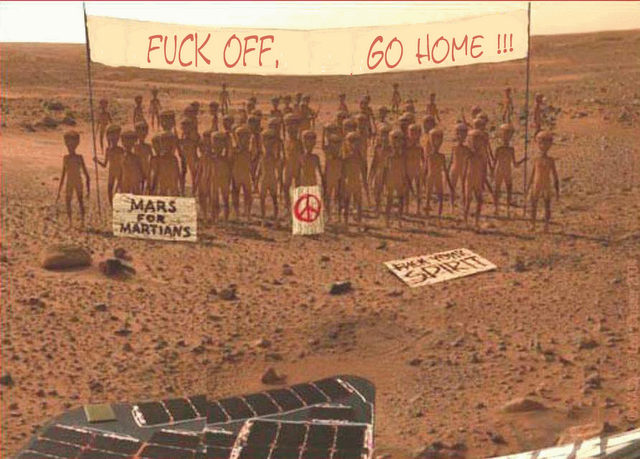
Mars


Thanks to Anel Viz and the Mars Lander.


I'm not so sure about this one -- seems like we may not be entirely welcome.


Maybe if we demonstrate that we can take care of our own world. . . .

Monday, March 26, 2012

Highs and Lows

Nope, not about politics -- that's pretty much lows these days. It's about mountains and deep sea trenches, in the news because director James Cameron just dove to 35,756 feet below sea level. That's in the Marianas Trench, which is fairly close to Japan.


There are a number of trenches in the oceans, places where one plate of the crust is being forced under another, also known as "subduction zones." The Mariana Islands, which are right there at the edge, are the result of volcanism from the activity of the two plates. But the Marianas Trench is the deepest.

That got me to thinking: what's the highest point above sea level? Well, yes, it's still Mt. Everest, at 29,029 feet. It's probably safest to stick with "above sea level" because if you start looking at "highest mountains," you have to take into account sea mounts. Mauna Kea, for example, is only 13,802 feet above sea level. From its base, however, it measures 33,474 feet. That's over six miles -- normal cruising altitude for a commercial jet liner.


And yet, all these mountains and trenches are just bumps and wrinkles on the surface of the earth. Just to put things in perspective.

Footnote: Think about cranes. They summer in Siberia, and then migrate to India and Southeast Asia in the winter. Over the Himalayas. That's pretty amazing.

Sunday, January 15, 2012

You Have to Wonder

just how unique human beings are:


After watching a snowboarding crow, I have to think maybe not so much.

Saturday, February 05, 2011

Traveling in Time

We're doing it, but not the way you might expect. Get this.


Astronomers have pushed the NASA/ESA Hubble Space Telescope to its limits by finding what is plausibly the most distant and ancient object in the Universe [1] ever seen. Its light has travelled for 13.2 billion years to reach Hubble [2], which corresponds to a redshift around 10. The age of the Universe is 13.7 billion years.

The dim object, called UDFj-39546284, is likely to be a compact galaxy of blue stars that existed 480 million years after the Big Bang, only four percent of the Universe’s current age. It is tiny. Over one hundred such mini-galaxies would be needed to make up our own galaxy, the Milky Way.


Remember, what they're seeing was happening 13.2 billion years ago. Our earth hasn't even been here that long.

Makes you think.

Thursday, February 03, 2011

Extrasolar

An artist's impression of the densely packed Kepler 11 system shows three planets transiting in front of their host star simultaneously. Image: NASA/Ames/JPL-Caltech/T. Pyle

There's lots of planets out there:

Kepler is well on its way to vastly augmenting the roster of known exoplanets, of which there are now 500 or so, and may have already gotten a whiff of several potentially habitable worlds. "We have 54 planets in the habitable zone of their stars," Borucki says, referring to the temperate orbital zone around a star that would allow for the existence of liquid water on a planet. "One of them is 0.9 times the radius of the Earth, and four of them are less than two Earth radii." Any of those would be the most Earth-like world ever detected outside the solar system. What is more, some of the larger, more Jupiter-like planets Kepler is sniffing at in the habitable zone might have moons, and some of those satellites would themselves be potentially habitable. "It's sort of awesome," Borucki says of Kepler's haul. "The implications are that there are an awful lot of planets out there."

Saturday, November 13, 2010

This Is Cool

From NYT:

Something big is going on at the center of the galaxy, and astronomers are happy to say they don’t know what it is.

A group of scientists working with data from NASA’s Fermi Gamma-Ray Space Telescope said Tuesday that they had discovered two bubbles of energy erupting from the center of the Milky Way galaxy. The bubbles, they said at a news conference and in a paper to be published Wednesday in The Astrophysical Journal, extend 25,000 light years up and down from each side of the galaxy and contain the energy equivalent to 100,000 supernova explosions.


And this is what it looks like:

From end to end, the newly discovered gamma-ray bubbles extend 50,000 light-years, or about half of the Milky Way’s diameter, as shown in this illustration.

Friday, November 05, 2010

Wow!

Amazing pictures of a comet passing:


It's weird -- the comet is shaped like a dumbbell. I always just thought of them as lumps.

Sunday, October 17, 2010

The Universe

is an amazing place. Take a look at the pictures in this post -- it's a gas cloud where stars are being formed. This one is fascinating:


That's a new star shooting out streams of -- well, streams of something.  Read the article.

Wednesday, September 08, 2010

Star Guts

It's also been called a stellar "pearl necklace." Rather awesome, don't you think?


Wednesday, April 29, 2009

Cool


Or actually, very hot, I would guess. Here's a report on the oldest thing we've found so far: a star that exploded 13 billion years ago.

Analysis of the light spectrum confirmed the blast had a redshift of 8.2. Redshift is a measure of the degree to which light has been "stretched" by the expansion of the Universe. The greater the redshift, the more distant the object and the earlier it is being seen in cosmic history.

The figure 8.2 equates to a distance of 13.035 billion light-years. Put another way, the explosion is being viewed when the Universe was only 630 million years old, a mere one-20th of its current age (estimated to be 13.7 billion years old).

The previous record holder was a GRB witnessed, also by Swift, in September 2008. It had a redshift of 6.7, making it 190 million light-years closer than GRB 090423.

Scientists have seen what they believe may be faint galaxies at redshifts 8-10, but their true nature is still being investigated.

Researchers are very keen to probe these great distances because they will learn how the early Universe evolved, and that will help them explain why the cosmos looks like it does now.


Just a little something to keep you humble.