Showing posts with label in memoriam. Show all posts
Showing posts with label in memoriam. Show all posts
Sunday, September 20, 2020
In Memoriam
Ruth Bader Ginsburg (1933-2020)
I think she would have appreciated the image, which is a collage by Ghillermo Rojo titled "Annunciation".


Saturday, July 18, 2020
In Memoriam: John Lewis
Who died yesterday at age 80.
I really don't have much to add, except that we need more like him.
Via Bark Bark Woof Woof.
Representative John Lewis, a son of sharecroppers and an apostle of nonviolence who was bloodied at Selma and across the Jim Crow South in the historic struggle for racial equality, and who then carried a mantle of moral authority into Congress, died on Friday. He was 80.
His death was confirmed in a statement by Nancy Pelosi, the speaker of the House of Representatives.
Mr. Lewis, of Georgia, announced on Dec. 29 that he had Stage 4 pancreatic cancer and vowed to fight it with the same passion with which he had battled racial injustice. “I have been in some kind of fight — for freedom, equality, basic human rights — for nearly my entire life,” he said.
On the front lines of the bloody campaign to end Jim Crow laws, with blows to his body and a fractured skull to prove it, Mr. Lewis was a valiant stalwart of the civil rights movement and the last surviving speaker at the historic March on Washington for Jobs and Freedom in 1963.
I really don't have much to add, except that we need more like him.
Via Bark Bark Woof Woof.
Thursday, October 17, 2019
In Memoriam
Damn. Elijah Cummings has passed.
This is a disaster.
Representative Elijah E. Cummings, a son of sharecroppers who rose to become one of the most powerful Democrats in Congress and a central figure in the impeachment investigation of President Trump, died on Thursday in Johns Hopkins Hospital in Baltimore. He was 68.
His death was confirmed by a spokeswoman, Trudy Perkins, in a statement that said he died of “complications concerning longstanding health challenges.” No other details were given. Mr. Cummings had been ailing in recent years and used a motorized wheelchair.
This is a disaster.
Sunday, January 20, 2019
Review: Mary Oiver: A Poetry Handbook
Mary Oliver, who won the Pulitzer Prize in Poetry for her collection American Primitive, has died at 83. Somehow, I've managed to not read her poetry, although I did read this one, once upon a time. Another from the late, great Epinions.
 Mary Oliver’s A Poetry Handbook is one of those books on writing that I think will become a workbook for anyone interested in poetry.
Oliver is quite clear in her introduction that, like most people, she firmly believes that making poetry is not something that can be taught in school; like painting, music, and other forms of art, one can learn the craft, but the vision can’t be taught. This book is about the craft of poetry, pure and simple: types of verse, rhyme schemes, the line, meter. She also makes a point, very early in the book, about the value of reading poetry for those who would write it, and about imitating the masters (fine as a learning tool – don’t let it become a trap). Oliver builds the discussion as an organic whole, beginning with sound, which, after all, is one of the things that makes poetry poetry: the music of the spoken word. From there, it is a logical and natural progression to rhyming, the structure of the line, various forms (with a very intelligent and sensitive discussion of free verse, which is much more difficult than most people think), and a lot of common sense on diction and imagery.
The various sections are beautifully illustrated by examples by a wide range of poets, from Bashō, Emily Dickinson, T. S. Eliot, Marianne Moore, William Carlos Williams, William Butler Yeats, and more, both household words and treasures known to few outside those who make poetry part of their regular diet. The illustrations are, for the most part, subject to incisive and intelligent analysis in the text that relates them firmly to the topic at hand – aside from being a joy to read in and of themselves.
Oliver also takes on those two bêtes noires of any writer, discipline and revision, with, again, remarks based firmly on common sense. (Make appointments with your Muse – and keep them.). She has words to say as well about the relative merits of writing groups, workshops, and solitude. (As one who values his solitude but thinks that enough is enough and is looking for a local writing group to join, I am taking her words to heart – they make a lot of sense: you need to be alone to write, but without input, you have nothing to write about that’s going to be worth reading.)
This is also a book that will be inestimably valuable to readers of poetry, simply because knowing what tools the poet has available, which ones he chose to use, and how she used them, can’t help but increase your understanding and enjoyment. In fact, Oliver stresses that, until the early years of this century, poetry was strongly metrical and rhymed; we are now unused to that, since free verse and blank verse have become the norm, and rhyme is for greeting cards. Consequently, many contemporary readers find the great poets of the English language difficult or incomprehensible, simply because of unfamiliarity, which is sad and unnecessary. (To be perfectly honest, rhymed verse makes me crazy, unless it’s Sir Thomas Wyatt or John Donne. OK – I suppose I can handle Yeats, too.)
Although I can’t claim to have perused every handbook on the craft of poetry, of those that I’ve looked at, Oliver’s stands out as a gem: clear, concise, intelligent, and sensible. What more can you ask? A definite must for any writer’s – or reader’s – library.
(A note: This one appears to undergo revision and expansion periodically – I’ve found copies in my local used bookstores, and, while there seem to be more examples in my edition, the meat of the text seems to be substantially intact. Happy browsing.)
(Mariner Books, 1994)
Oliver is quite clear in her introduction that, like most people, she firmly believes that making poetry is not something that can be taught in school; like painting, music, and other forms of art, one can learn the craft, but the vision can’t be taught. This book is about the craft of poetry, pure and simple: types of verse, rhyme schemes, the line, meter. She also makes a point, very early in the book, about the value of reading poetry for those who would write it, and about imitating the masters (fine as a learning tool – don’t let it become a trap). Oliver builds the discussion as an organic whole, beginning with sound, which, after all, is one of the things that makes poetry poetry: the music of the spoken word. From there, it is a logical and natural progression to rhyming, the structure of the line, various forms (with a very intelligent and sensitive discussion of free verse, which is much more difficult than most people think), and a lot of common sense on diction and imagery.
The various sections are beautifully illustrated by examples by a wide range of poets, from Bashō, Emily Dickinson, T. S. Eliot, Marianne Moore, William Carlos Williams, William Butler Yeats, and more, both household words and treasures known to few outside those who make poetry part of their regular diet. The illustrations are, for the most part, subject to incisive and intelligent analysis in the text that relates them firmly to the topic at hand – aside from being a joy to read in and of themselves.
Oliver also takes on those two bêtes noires of any writer, discipline and revision, with, again, remarks based firmly on common sense. (Make appointments with your Muse – and keep them.). She has words to say as well about the relative merits of writing groups, workshops, and solitude. (As one who values his solitude but thinks that enough is enough and is looking for a local writing group to join, I am taking her words to heart – they make a lot of sense: you need to be alone to write, but without input, you have nothing to write about that’s going to be worth reading.)
This is also a book that will be inestimably valuable to readers of poetry, simply because knowing what tools the poet has available, which ones he chose to use, and how she used them, can’t help but increase your understanding and enjoyment. In fact, Oliver stresses that, until the early years of this century, poetry was strongly metrical and rhymed; we are now unused to that, since free verse and blank verse have become the norm, and rhyme is for greeting cards. Consequently, many contemporary readers find the great poets of the English language difficult or incomprehensible, simply because of unfamiliarity, which is sad and unnecessary. (To be perfectly honest, rhymed verse makes me crazy, unless it’s Sir Thomas Wyatt or John Donne. OK – I suppose I can handle Yeats, too.)
Although I can’t claim to have perused every handbook on the craft of poetry, of those that I’ve looked at, Oliver’s stands out as a gem: clear, concise, intelligent, and sensible. What more can you ask? A definite must for any writer’s – or reader’s – library.
(A note: This one appears to undergo revision and expansion periodically – I’ve found copies in my local used bookstores, and, while there seem to be more examples in my edition, the meat of the text seems to be substantially intact. Happy browsing.)
(Mariner Books, 1994)
Sunday, August 26, 2018
In Memoriam: John McCain

John McCain died yesterday:
John McCain, who endured more than five years as a prisoner of war in Vietnam before becoming the 2008 Republican presidential nominee and serving Arizona for more than 30 years on Capitol Hill, died Saturday at age 81.
McCain died at 4:28 p.m., his office announced. His wife, Cindy, and other family members were with him.
Destined to be remembered among the political giants of Arizona history, the six-term U.S. senator disclosed in July 2017 that he had been diagnosed with a deadly form of brain cancer called glioblastoma.
At one time I considered McCain one of the few true statesmen in Washington, and then he seemed to junk principle for party. However, he somewhat redeemed himself by standing in open opposition to Trump.
We won't mention the White House's empty response, but this is worth noting. From Barack Obama:
John McCain and I were members of different generations, came from completely different backgrounds, and competed at the highest level of politics. But we shared, for all our differences, a fidelity to something higher-the ideals for which generations of Americans and immigrants alike have fought, marched, and sacrificed.
We saw our political battles, even, as a privilege, something noble, an opportunity to serve as stewards of those high ideals at home, and to advance them around the world. We saw this country as a place where anything is possible – and citizenship as our patriotic obligation to ensure it forever remains that way.
Few of us have been tested the way John once was, or required to show the kind of courage that he did. But all of us can aspire to the courage to put the greater good above our own. At John’s best, he showed us what that means. And for that, we are all in his debt. Michelle and I send our heartfelt condolences to Cindy and their family.
I have nothing to add to that.
Wednesday, March 14, 2018
In Memoriam: Stephen Hawking
Noted physicist Stephen Hawking is dead at 76:
Via Joe.My.God. There's much more at the link.
And here's a nice discussion of his attitude toward his life.
Stephen Hawking - who died aged 76 - battled motor neurone disease to become one of the most respected and best-known scientists of his age.
A man of great humour, he became a popular ambassador for science and was always careful to ensure that the general public had ready access to his work.
His book A Brief History of Time became an unlikely best-seller although it is unclear how many people actually managed to get to the end of it.
Via Joe.My.God. There's much more at the link.
And here's a nice discussion of his attitude toward his life.
Wednesday, January 24, 2018
In Memoriam
Ursula K. LeGuin, 1929-2018:
Oddly enough, I've only reviewed one of LeGuin's books ,Gifts, which review is not available right now but will be showing up at Green Man Review sometime in the (relatively) near future. I did include her in a series of essays on sexual identity in science fiction, which, alas, is no longer available online and seems to be missing from my files. She was one of the science fiction/fantasy writers of the 1970s and '80s who redrew the map, so to speak, on what was permissible in the genre in terms of sex and gender. The Left Hand of Darkness was one of the ground-breakers in that regard; if you've never read it, hunt up a copy.
I didn't agree with her statement that genre was a marketing tool for publishers; there's a lot more to genre fiction than that, in that each genre has its own tropes and its own landscape, so to speak.
At any rate, there are some people who should live forever. LeGuin was one of them.
 |
| Photo: Wikimedia Commons |
Acclaimed science-fiction author Ursula K. Le Guin died Monday in her hometown of Portland, Ore., her agent confirmed. Le Guin was 88.
Although best known for her science fiction — particularly the Earthsea series — Le Guin was a creative, curious writer whose more than two dozen books encompassed fiction, poetry, essays, criticism, children's books, works of translation, fantasy and even blogging.
Oddly enough, I've only reviewed one of LeGuin's books ,Gifts, which review is not available right now but will be showing up at Green Man Review sometime in the (relatively) near future. I did include her in a series of essays on sexual identity in science fiction, which, alas, is no longer available online and seems to be missing from my files. She was one of the science fiction/fantasy writers of the 1970s and '80s who redrew the map, so to speak, on what was permissible in the genre in terms of sex and gender. The Left Hand of Darkness was one of the ground-breakers in that regard; if you've never read it, hunt up a copy.
I didn't agree with her statement that genre was a marketing tool for publishers; there's a lot more to genre fiction than that, in that each genre has its own tropes and its own landscape, so to speak.
At any rate, there are some people who should live forever. LeGuin was one of them.
Wednesday, September 06, 2017
Friday, July 21, 2017
Culture Break: In Memoriam, Chester Bennington
Chester Bennington, lead singer of Linkin Park, reportedly has committed suicide:
"Powerless," which I think is one of the band's most affecting songs:
Law enforcement sources tell us the singer hanged himself at a private residence in Palos Verdes Estates in L.A. County. His body was discovered Thursday just before 9 AM.
Chester was married with 6 children from 2 wives.
The singer struggled with drugs and alcohol for years. He had said in the past he had considered committing suicide because he had been abused as a child by an older male.
"Powerless," which I think is one of the band's most affecting songs:
Tuesday, September 06, 2016
In Memoriam: Phyllis Schlafly
I try not to say anything negative about the departed, so in this case I'm going to let Sarah, Proud and Tall say it for me:
There are lots of disgusting people occupying places in America's public discourse, the Schlafly was one of the worst.
Betty Bowers, America's Best Christian, put it much more succinctly:
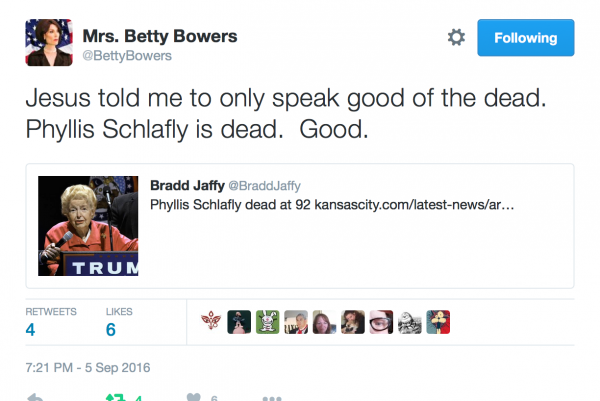
She was a nasty, hypocritical old baggage – she believed in jobs and power for her, but not for other women, that there was no rape inside marriage, that Anthony Kennedy should have been impeached for abolishing the death penalty for minors, and that all Muslims should be banned from the armed forces and political office.
She endorsed Donald Trump, but that might just have been because she was bats at the end.
She was a prude whose hatred of sex and those who dared to have it – in particular those who she thought God had cursed with disease for having it – somehow made her the respectable face of a campaign to stigmatise people with HIV and AIDS (and not just the gays) which gave the Reagan administration cover to ignore the AIDS crisis, held back AIDS education and funding of AIDS research for years, and therefore directly or indirectly resulted in the deaths of hundreds of thousands of people and the infection of twice that many again.
There are lots of disgusting people occupying places in America's public discourse, the Schlafly was one of the worst.
Betty Bowers, America's Best Christian, put it much more succinctly:
Tuesday, August 30, 2016
In Memoriam: Gene Wilder
I can't admit to being a Gene Wilder fan -- I'm not really a fan type -- but I did enjoy everything I ever saw him in. He really was an offbeat comic genius.
Here's the NYT obit.
And here's the "greatest moments" from Young Frankenstein:
Here's the NYT obit.
And here's the "greatest moments" from Young Frankenstein:
Wednesday, June 15, 2016
Culture Break: Samuel Barber: Adagio for Strings
As performed by the Kronos Quartet, which is the best version I've ever heard. Since the piece was originally the second movement of his String Quartet, Op. 11, this seems appropriate.
In memory of Orlando.
In memory of Orlando.
Monday, June 13, 2016
Tuesday, May 31, 2016
Today's Must-Read: Memorial Day Edition
I know, I'm a day late, but the heat had built up so much in my apartment that I literally couldn't think. At any rate, Batocchio gets it right at Hullabaloo:
I forget who said it, but I ran across this idea as a history student: War is the last resort, after diplomacy has failed. Too many people in this country have started to think that was is the first option. That's not how you keep the peace.
Memorial Day is meant for remembering those who died in military service (a worthy commemoration). It's also a holiday that naturally spurs thoughts of civilians killed in war, of living veterans and how they're treated, and how war is discussed in our country. It's only right to pause and remember the dead. And perhaps the best way to honor them the other days of the year is by challenging the belligerati who believe that casually and aggressively endorsing war or torture somehow makes them tough or makes the nation safer.
I forget who said it, but I ran across this idea as a history student: War is the last resort, after diplomacy has failed. Too many people in this country have started to think that was is the first option. That's not how you keep the peace.
Friday, April 22, 2016
In Memoriam: Prince

I can't say that I was ever a real fan, although I did enjoy his music. I certainly can't deny, though, that he had a huge impact on American popular music.
Friday, December 06, 2013
In Memoriam: Nelson Mandela

There are three iconic figures in the 20th century that, more than any others, embody the struggle for equality: Mahatma Gandhi, Martin Luther King, Jr., and Nelson Mandela.
And now Mandela is gone.
We need more like them.
Here's South African President Jacob Zuma's announcement:
Here's President Obama's statement:
And here's Rachel Maddow's segment on Mandela's legacy.
It's sobering to realize what native Africans in South Africa had to endure under apartheid.
Saturday, August 25, 2012
"One giant leap for mankind."
We watched the moon walk on TV. My cat kept trying to catch the astronauts, and then would run around to the back of the TV to see if they were back there.
Sunday, August 05, 2012
Quote of the Day
“If you can’t say something good about someone, sit right here by me.”
— Alice Roosevelt Longworth
With thanks to Kathleen Geier at Washington Monthly.
Friday, March 02, 2012
In Memoriam
This is an unusual In Memoriam post for me -- usually I reserve these for those I will miss. Not in this case: Andrew Breitbart is dead at 43.
I won't go out of my way to speak ill of the dead -- there's no point, really. I despised his public persona and his tactics when he was alive, and I see no reason to change my opinion now. (Needless to say, I didn't know him personally, but I wonder if that would have changed my opinion of him. I do know people whose attitudes and methods I disdain, and I get along with them because in context, I have to. They are not friends.) So don't look for anything from me like Alyssa Rosenberg's comments, which read like a puff piece in the service of "even-handedness." The man was pernicious, a liar and demagogue, who did more damage in his brief career than most manage in their entire lives. His influence was, in my mind, a complete negative. (And for Rosenberg's commentary, to divorce the man as "showman and provocateur" from the ends to which those characteristics were enlisted misses the point.)
The problem is, that influence is not going to go away. Gaius Publius has noted that the conspiracy theories have already taken wing -- Obama had him killed.
I'm sure there are people who will miss him. David Atkins sums up my feelings pretty well.
I won't go out of my way to speak ill of the dead -- there's no point, really. I despised his public persona and his tactics when he was alive, and I see no reason to change my opinion now. (Needless to say, I didn't know him personally, but I wonder if that would have changed my opinion of him. I do know people whose attitudes and methods I disdain, and I get along with them because in context, I have to. They are not friends.) So don't look for anything from me like Alyssa Rosenberg's comments, which read like a puff piece in the service of "even-handedness." The man was pernicious, a liar and demagogue, who did more damage in his brief career than most manage in their entire lives. His influence was, in my mind, a complete negative. (And for Rosenberg's commentary, to divorce the man as "showman and provocateur" from the ends to which those characteristics were enlisted misses the point.)
The problem is, that influence is not going to go away. Gaius Publius has noted that the conspiracy theories have already taken wing -- Obama had him killed.
I'm sure there are people who will miss him. David Atkins sums up my feelings pretty well.
Sunday, February 12, 2012
In Memoriam
Whitney Houston, dead at 48.
I hadn't realized that her mother was Cissy Houston, and that Dionne and DeeDee Warwick were her cousins. And Aretha Franklin was her godmother.
Gods, she was beautiful.
I can't leave it at one clip:
I hadn't realized that her mother was Cissy Houston, and that Dionne and DeeDee Warwick were her cousins. And Aretha Franklin was her godmother.
Gods, she was beautiful.
I can't leave it at one clip:
Subscribe to:
Posts (Atom)